Benefits of Chain of Responsibility (CoR) Online Training

What is Chain of Responsibility (CoR) Training?

Chain of Responsibility (CoR) training ensures everyone in the transport supply chain understands their legal obligations under the Heavy Vehicle National Law (HVNL). This includes:

  • Consignors and consignees
  • Schedulers, Packers and loaders
  • Drivers and vehicle operators
  • Business owners, executive officers, and managers

If your team influences heavy vehicle safety – directly or indirectly – they must understand their responsibilities under CoR legislation.

Why Is Chain of Responsibility Online Training Important?

With the evolution of HVNL and CoR legislation, workplaces must update their safety systems and training strategies. Online CoR training is one of the most efficient ways to build HSE knowledge and reduce compliance risks.


Benefits of Chain of Responsibility eLearning include:

  • Greater legal awareness across the business
  • Improved transport safety culture
  • Reduced breaches and liability risks
  • Convenient and flexible learning
  • Cost-effective compliance

The Benefits of Chain of Responsibility Online Training

1. Flexible, Self-Paced Learning

Employees can complete training at their own pace, fitting it around shifts or downtime. Like watching on-demand TV, learners appreciate the ability to complete modules when it suits them best.


2. Engaging Learning Formats

The best chain of responsibility online training uses multiple formats to suit all learning styles:

  • Video and audio content
  • Quizzes and assessments
  • Case studies and real-world scenarios
  • Interactive activities
  • Visuals and diagrams


3. Reduced Costs and Disruption

Online training requires only a device and internet connection, eliminating:

  • Travel and accommodation costs
  • Training room hire
  • Lost productivity from full-day training sessions
  • It’s a scalable solution whether you have 5 staff or 500.


4. Faster Learning Outcomes

Digital delivery shortens time to completion, allowing employees to apply learning immediately and managers to track progress in real-time.


5. Accessible Anywhere in Australia

Whether your staff are in metro cities or remote regions, everyone gets equal access to high-quality CoR training online.

Why Choose Zenergy Online Training?

Why choose our training?

  • Our experienced consultants work closely with businesses to support compliance and certification with Australian regulatory requirements.
  • Delivered fully online, our courses provide a convenient and efficient way for organisations to upskill their teams.
  • Self-paced access allows participants to complete training when it suits them, helping organisations keep their workforce compliant with current Australian regulations.


How learning is delivered?

  • Each online eLearning course is designed to suit a range of learning styles, using text, audio, images, and video.
  • Learning is reinforced through built-in quizzes, case studies, practical activities, and scenario-based exercises.


Completion and certification?

  • Participants who successfully complete the module and assessment questions will receive a Certificate of Completion.


Our Chain of Responsibility training online is especially useful for businesses managing compliance across multiple locations.


Zenergy CoR Online Training

CoR Online eLearning courses via the Zenergy Training Portal which includes the following courses:

Chain of Responsibility (CoR) for Owners, Senior Management, Managers


This course explains the key requirements of the Heavy Vehicle National Law (HVNL) and the Chain of Responsibility (CoR), which supports the safe and productive transport of goods and people by heavy vehicles and includes an overview of the HVNL and Regulations, the primary CoR duties and obligations, and the responsibilities of supply chain parties to ensure, so far as is reasonably practicable, the safety of transport activities.


Learn more about this course and get this course here.

Chain of Responsibility (CoR) for Operational Staff


This course outlines the requirements and obligations relating to fatigue management, speed compliance, heavy vehicle safety and roadworthiness, and load management, including mass, dimension, and load restraint, and how these areas relate to the Chain of Responsibility and the Heavy Vehicle National Law and outlines the key risks and practical steps for managing them in accordance with legal requirements.


Learn more about this course and get this course here.

Chain of Responsibility (CoR) for HV Drivers


This course explains the key requirements for drivers under the Heavy Vehicle National Law (HVNL) and the Chain of Responsibility (CoR), which supports the safe and productive transport of goods and people by heavy vehicles.


Learn more about this course and get this course here.

Custom CoR eLearning Solutions for Your Business

Need a more tailored approach?


Zenergy specialises in designing and customising company-specific CoR training programs based on your existing procedures and operational risks. These can be hosted:


If your organisation is seeking the ability to host courses internally or deliver training tailored to your unique requirements, Zenergy’s Learning Management System (LMS) provides a solution designed to address your workplace’s safety requirements and objectives.


We manage setup, updates, and all technical aspects –no IT team required.


Zenergy’s Learning Management System (LMS) secure LMS platform:

  • Centralises all training content
  • Tracks user progress and completions
  • Manages certifications and records
  • Supports Australian compliance standards


It’s the complete solution for delivering and managing Chain of Responsibility online training.

Need Support with Chain of Responsibility (CoR) Online Training?

If you're looking to meet your Chain of Responsibility requirements nationally, Zenergy has you covered.


Zenergy’s range of CoR eLearning training programs can help transform your workforce and provide them with job-ready skills to help your business achieve its objectives. You can find outmore about the courses that Zenergy provides on Zenergy HSE & CoR eLearning Programs or alternatively, contact our team today to find the right training solution for your business.


Reach out to Zenergy on 1300 333 400 or info@zenergygroup.com.au where we can discuss your needs.


Contact Us

Zenergy News

By Dean Woods • October 19, 2026
WorkSafe Victoria is investigating fake safety qualifications. How employers should verify tickets, licences and real competency when hiring HSE talent.
Zenergy Take 5: WHS News for the Week of 19 October 2026
By Dean Woods • October 19, 2026
Queensland’s psych injury claims shake-up, fake safety certificates under investigation, fresh job market data and this week’s featured HSE role.
Zenergy Congratulates the 2026 AWHSA Finalists
By Dean Woods • October 13, 2026
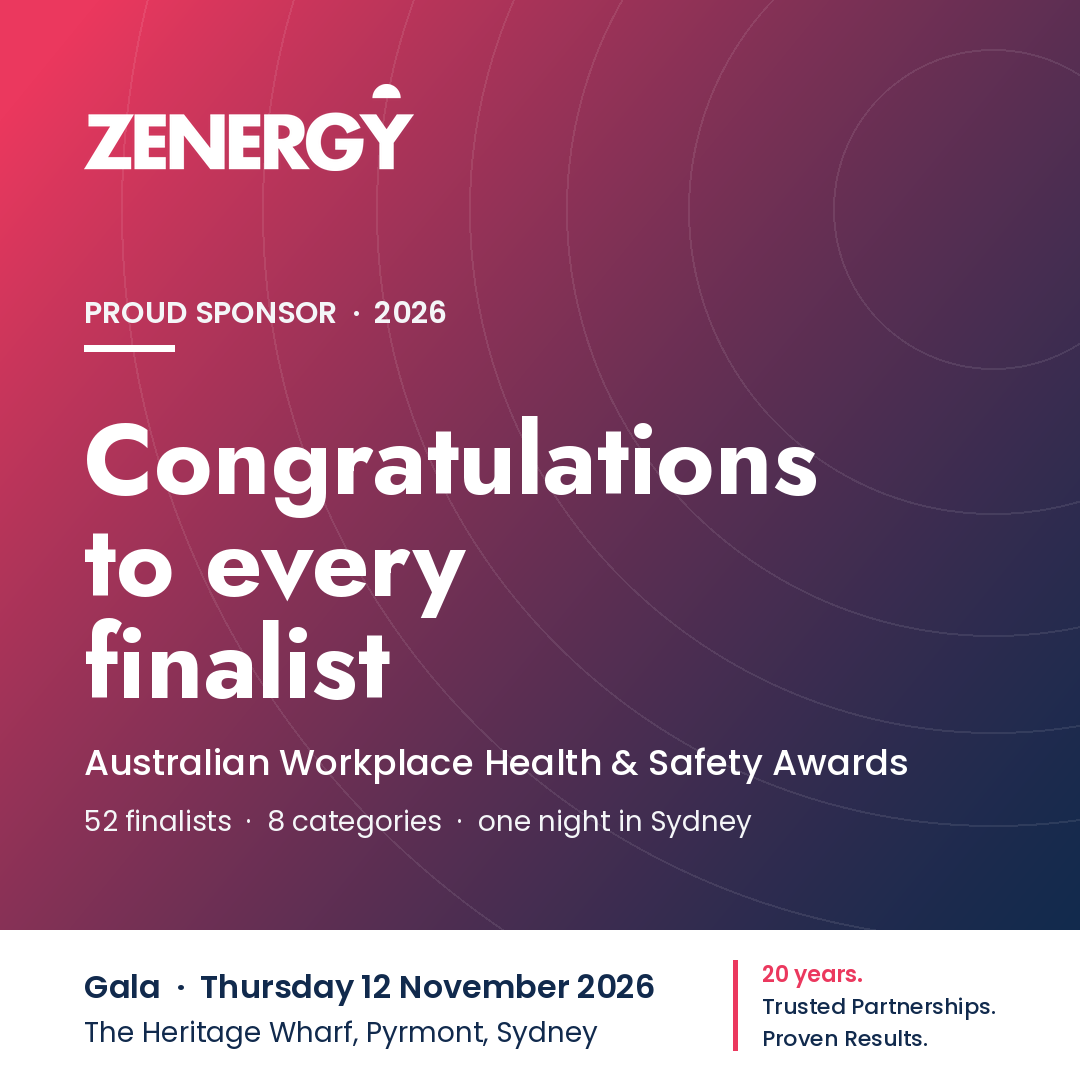
Zenergy is proud to sponsor the 2026 Australian Workplace Health & Safety Awards. Meet the 52 finalists ahead of the Sydney gala on 12 November.
By Dean Woods • October 13, 2026
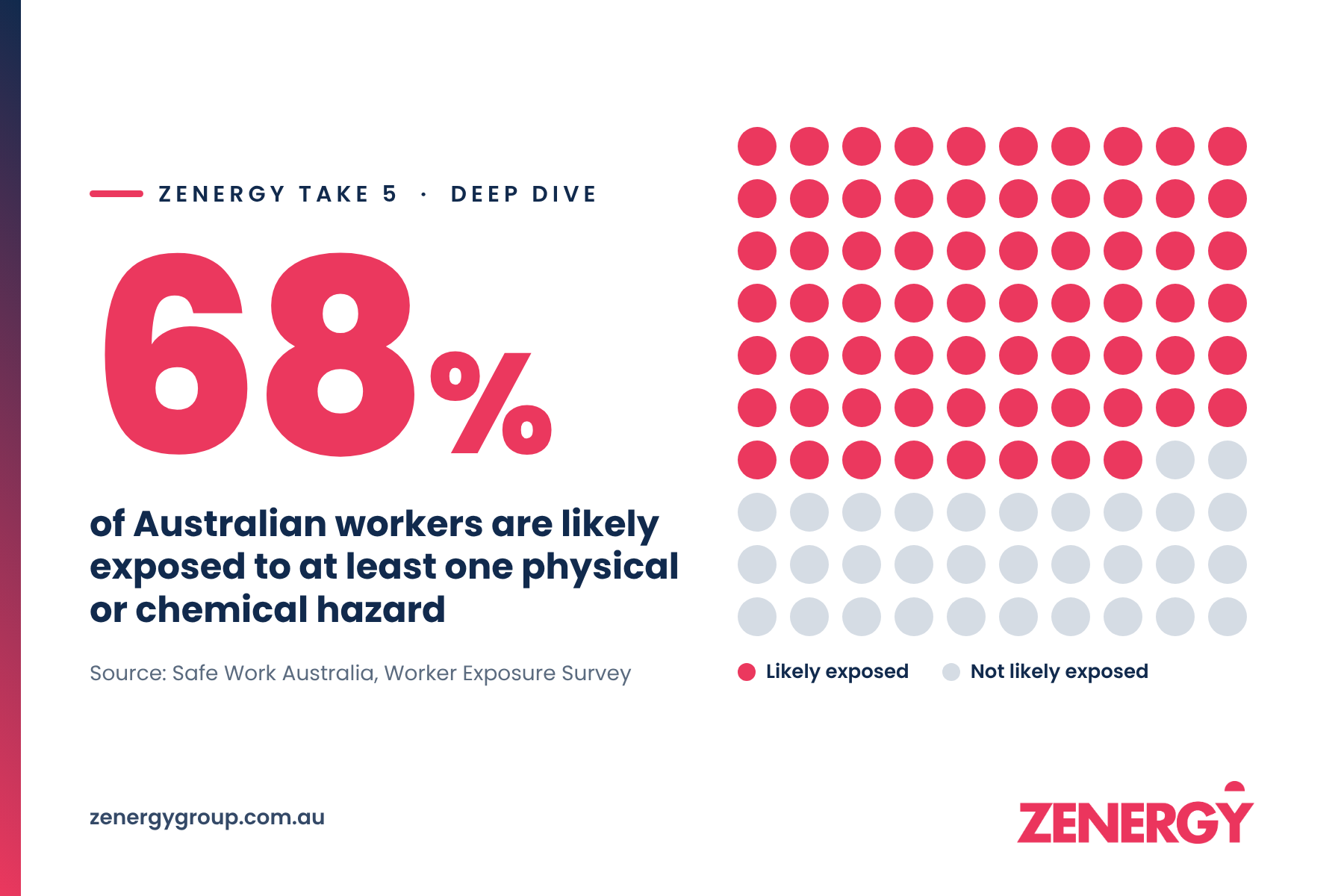
Welcome to Take 5, Zenergy's weekly five-minute scan of what's moving in Australian workplace health and safety, workers compensation and people & culture — five items, one featured senior role, every source named. This week: a hard regulatory deadline lands on the calendar, Safe Work Month hits its stride, and Safe Work Australia publishes the clearest picture in years of who is actually exposed to harm at work. 1. New workplace exposure limits commence 1 December — including Australia's first diesel particulate limit The transition period for Safe Work Australia's updated workplace exposure limits (WELs) for airborne contaminants ends on 1 December 2026. The list introduces Australia's first national exposure limit for diesel particulate matter — 0.01 mg/m³, measured as respirable elemental carbon — alongside revised limits for a range of other contaminants. Regulators are telling duty holders to use the remaining weeks to review exposure monitoring, confirm controls are effective, and prioritise elimination and engineering controls over reliance on RPE. If your operations involve diesel plant in enclosed or poorly ventilated environments — distribution centres, tunnels, underground mining, workshops — this is the compliance item to table at your next leadership meeting. Safe Work Australia has published guidance and a transition toolkit, and state regulators including SafeWork SA have flagged the change, as has NOPSEMA for offshore operators. Sources: Safe Work Australia — Changes to Workplace Exposure Limits (safeworkaustralia.gov.au); SafeWork SA — Get ready for new Workplace Exposure Limits (safework.sa.gov.au); NOPSEMA — Diesel engine emissions: new workplace exposure limit takes effect December 2026 (nopsema.gov.au). 2. Dates ahead: Safe Work Month's “for health” week and World Mental Health Day National Safe Work Month is underway, with Safe Work Australia's 2026 theme “Safe work is for life” running week-by-week focuses: “for health” (week two, this week), “for the future” (week three) and “for all” (week four). World Mental Health Day falls on Saturday 10 October, inside Mental Health Month — a natural prompt to put psychological health on the toolbox agenda, not just the poster wall. Regulators are active too: SafeWork NSW opened the month with a compliance operation targeting the meat processing sector. Sources: Safe Work Australia — National Safe Work Month (safeworkaustralia.gov.au/national-safe-work-month); SafeWork NSW — news, 1 October 2026 (safework.nsw.gov.au). 3. People & culture: FWO recovers $453 million for workers in 2025–26 The Fair Work Ombudsman's 2025–26 results, released 14 September, show $453 million recovered for underpaid workers across the year, with Ombudsman Anna Booth urging employers to find “compliance common ground”. For employers, the signal hasn't changed: payroll governance, award classification and record-keeping sit alongside WHS as enterprise-level compliance risks — and the regulator's recovery capability keeps growing. Worth a standing item on the people & culture risk register, especially for businesses with large award-covered or labour-hire workforces. Source: Fair Work Ombudsman media release, 14 September 2026 (fairwork.gov.au/newsroom). 4. Job market pulse: national vacancies ease, HSE demand holds The ABS's August 2026 Job Vacancies figures (released 1 October) show 325,000 vacancies nationally — down 0.9% over the quarter and 1.3% over the year, and 31.2% below the May 2022 peak. Private sector vacancies fell 2.0% for the quarter while public sector vacancies rose 7.8%. Health care and social assistance remains the deepest vacancy pool at 54,300. Against that gently easing backdrop, safety hiring is holding its ground from WHS advisors in Melbourne manufacturing to safety leadership in Queensland logistics — a spread we read as steady, sector-broad demand for proven operators rather than a hiring spike. Sources: ABS — Job Vacancies, Australia, August 2026 (abs.gov.au); 5. Industry story of the week: 68% of workers likely exposed to at least one hazard Safe Work Australia's newly published Worker Exposure Survey finds 68% of Australian workers are likely exposed to at least one physical or chemical hazard at work, with 28.9% experiencing high-level exposure. Solar UV is the most common hazard (an estimated 4.87 million workers), silica exposure covers an estimated 2.04 million workers and is heavily concentrated in construction and mining, and apprentices and trainees are disproportionately exposed across heat, silica, lead and asbestos. Construction, agriculture and mining are the industries most likely to see multiple hazard exposure. It's the week's most important read for HSE leaders — and the subject of this week's Zenergy deep-dive, where we unpack what the numbers mean for exposure monitoring, young-worker supervision and the 1 December exposure limit deadline. Sources: Safe Work Australia — Worker Exposure Survey (safeworkaustralia.gov.au); Safety Solutions, 28 September 2026 — “Over two-thirds exposed to a physical or chemical hazard, workers survey reveals”

By Dean Woods • October 7, 2026
Safe Work Australia's Worker Exposure Survey finds 68% of workers exposed to hazards. What HSE leaders should do before new limits land on 1 Dec.
City skyline at sunset with tall modern buildings under a colorful orange and blue sky
September 16, 2026
Explore the latest Safe Work Australia updates for 2026, including WHS penalties, incident notification, AI, chemical exposure limits and regulatory changes.
More Posts