Inside Hyperscale Data Centre Safety: An Interview with HSEQ Manager Amendra Rama
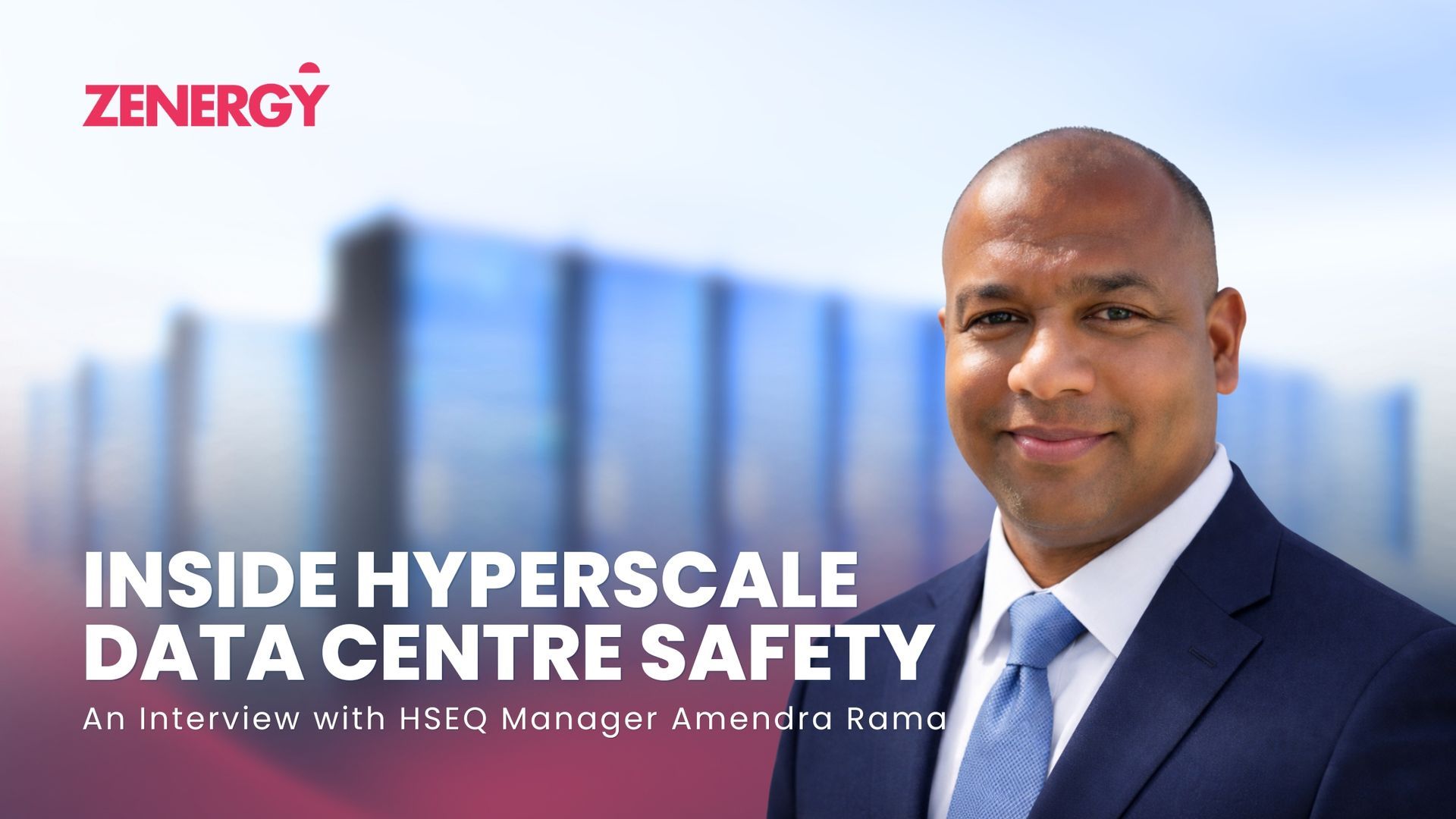
Australia's data centre sector is expanding at an unprecedented pace.
Driven by the rapid adoption of artificial intelligence (AI), cloud computing and digital transformation, billions of dollars are being invested in hyperscale data centres across the country. These facilities are critical to powering everything from enterprise technology to AI workloads—but behind the scenes, they also present some of the most complex Health, Safety and Environment (HSE) challenges in modern construction.
Unlike traditional commercial builds, hyperscale data centres combine accelerated delivery programs, high-voltage electrical infrastructure, simultaneous operations (SIMOPS) and critical uptime requirements, creating an environment where safety leadership must evolve alongside technology.
To explore these unique challenges, we spoke with Amendra Rama, HSEQ Manager. In his current role, Amendra leads HSEQ strategy, governance, risk management and compliance across major construction projects, including supporting commissioning, energisation and other high-risk construction activities.
Drawing on his experience working within critical infrastructure environments, Amendra shares why the most significant HSE risks often emerge towards the end of a project—and what organisations can do to manage them effectively.
Why Are Data Centre Construction Projects So Different?
When people think about construction safety, they often picture structural works, cranes or working at heights. According to Amendra, data centre construction introduces an entirely different level of complexity.
"One of the biggest differences with data centre construction is the level of high-voltage electrical and commissioning risk involved, particularly during energisation phases where systems transition from construction into live operational infrastructure."
Unlike conventional commercial developments, hyperscale data centres operate within fast-paced, high-pressure environments where multiple contractors, specialist vendors and client teams are working simultaneously.
Combined with critical uptime requirements, these projects demand exceptional coordination throughout every stage of delivery.
" A lot of the risk isn’t always visible during early construction it intensifies toward the end of the project during testing, commissioning and live integration, where strong governance, isolation management and contractor coordination become critical."
It's this shift from construction to live operational infrastructure that fundamentally changes the project's risk profile.
How Do Hyperscale Clients Approach HSE?
One of the defining characteristics of hyperscale clients is the maturity of their safety expectations.
Rather than viewing HSE as a compliance exercise, these organisations integrate safety into every stage of project delivery.
"Hyperscale clients generally operate with far more mature and risk-focused HSE expectations compared to traditional construction environments."
Amendra explains that these organisations place significant emphasis on:
- Governance and assurance
- Critical risk management
- Real-time project visibility
- Contractor performance
- Continuous monitoring of critical controls
The pace of delivery also demands disciplined execution.
"Teams are often working around live infrastructure, high-voltage systems and accelerated commissioning schedules, so there is very little margin for error."
While technology continues to evolve rapidly, Amendra believes successful projects aren't built on simply learning as they go.
"Continuous learning is essential as technology and operational demands evolve rapidly. However, the expectation is not to “learn as you go” Without structure, it’s about maintaining disciplined processes, strong contractor coordination and proactive risk management while adapting within highly dynamic environments."
The Biggest Lesson From Working Around High-Voltage Infrastructure
Throughout his career, one lesson has consistently stood out.
"One of the biggest lessons I've learned working around high-voltage infrastructure is that complacency is one of the greatest risks."
Experience alone isn't enough. Even highly capable teams can become comfortable in familiar environments, making strong systems and verification processes essential.
Amendra explains that the highest-risk periods often occur during commissioning and energisation, particularly when multiple contractors and live systems begin interacting.
"Strong isolation management, clear roles and responsibilities and robust permit controls become essential."
He also believes successful outcomes always begin long before work starts.
"High-voltage environments leave very little margin for error, so success ultimately comes down to preparation, competency and maintaining a strong safety culture under pressure."
Why Are Dedicated Substations Becoming So Important?
As AI and cloud computing continue driving demand for larger hyperscale facilities, electrical infrastructure has become one of the industry's biggest investments.
While some assume dedicated substations make facilities independent from the electricity grid, Amendra says that's only part of the story.
"It's less about being completely independent from the grid, and more about ensuring stable, secure and redundant power supply to support continuous uptime requirements."
Hyperscale facilities consume enormous amounts of electricity, requiring significant investment in:
- Dedicated substations
- Backup power systems
- Electrical resilience
- Long-term energy strategies
From an HSE perspective, this also introduces additional operational complexity.
"This also increases the complexity of commissioning, energisation and ongoing asset management, particularly where high-voltage systems and live operational environments intersect."
Can Safety Keep Up With Faster Project Delivery?
One of the biggest questions facing the industry is whether projects can continue accelerating without compromising safety. For Amendra, the answer is clear.
"The key is embedding safety into planning and delivery from the very beginning, rather than treating it as something separate from the program."
He believes safety and productivity should never compete.
"In hyperscale environments, speed and safety can’t operate in conflict they have to work together."
Projects that perform well typically share common characteristics:
- Strong planning from project inception
- Clear governance structures
- Disciplined contractor management
- Early identification of critical risks
- Consistent communication across all stakeholders
Conversely, problems often emerge when projects become reactive under schedule pressure.
"Maintaining strong critical control verification, communication and accountability across all stakeholders is what allows projects to move quickly while still managing risk effectively."
Building Infrastructure for an Uncertain Future
Hyperscale developments involve enormous capital investment.
Beyond the buildings themselves, organisations are investing heavily in resilient electrical infrastructure designed to support future growth in AI and cloud computing.
Amendra believes the industry recognises long-term demand but also acknowledges the uncertainty surrounding future capacity requirements.
"Clients are investing heavily not just in building capacity for today, but in creating resilient, scalable infrastructure that can support future operational demand and business continuity over the long term."
This long-term thinking reinforces the importance of designing safety systems that are equally scalable as facilities continue to grow.
Why Is Commissioning and Energisation Considered the Highest-Risk Phase?
Throughout our conversation, one theme consistently emerged: commissioning and energisation.
It's the phase where construction transitions into live operations—and where the consequences of failure become significantly greater.
Amendra explains: "The commissioning and energisation phase is often considered one of the highest-risk periods because it's the point where systems transition from construction into live operational infrastructure."
At this stage, multiple contractors, vendors and specialist teams often work simultaneously under significant schedule pressure.
Testing, isolation activities and system integration begin overlapping, rapidly increasing the project's complexity.
"Unlike earlier construction phases, there is very little margin for error during energisation. Strong planning, permit controls, communication and critical control verification become essential to safely manage both personnel and operational risk."
For HSE leaders, it's a reminder that some of the greatest risks occur after the building appears complete.
Final Thoughts: Safety Must Evolve With Critical Infrastructure
As Australia's investment in hyperscale data centres continues to grow, so too will the demand for experienced HSE professionals capable of managing increasingly complex risk environments.
From high-voltage infrastructure and commissioning through to contractor governance and operational integration, data centre projects require a level of planning, coordination and discipline that extends well beyond traditional construction practices.
For Amendra, the lesson is simple. Safety isn't something that slows delivery—it is what enables successful delivery.
And in an industry where the margin for error continues to shrink, strong leadership, preparation and collaboration remain the foundations of every successful project.
Looking to strengthen your health, safety or environmental team?
Zenergy works with organisations across Australia to find the right people, whether you need a permanent employee, interim contractor or executive leader.
We also provide HSE consulting and workplace training to help businesses improve safety performance, meet compliance requirements and build long-term capability.
Whether you're hiring, looking for specialist advice or investing in workforce development, our team is here to help.
Call us on 1300 333 400 or email info@zenergygroup.com.au to discuss how Zenergy can support your organisation.
Contact Us
Zenergy News