Why Australia's Best HSE Professionals Are Becoming Harder to Recruit in 2026

Australia's demand for experienced Health, Safety and Environment (HSE) professionals continues to outpace the supply of candidates with the right combination of technical expertise, leadership capability and industry experience.
At Zenergy, we are seeing this shift directly across the HSE recruitment market. Employers are not simply looking for people who understand WHS legislation or hold the right qualifications. They increasingly need HSE professionals who can operate confidently in complex environments, influence operational leaders, manage contractors, respond to risk and contribute to broader business objectives.
At the same time, experienced HSE professionals have more choice about where, when and how they work. The result is a more competitive HSE recruitment market — particularly for experienced HSE Managers, senior advisors and specialist professionals.
Why are HSE professionals becoming harder to recruit?
The challenge is not simply a shortage of people with HSE qualifications. The real challenge is finding professionals with the right level of experience, leadership capability and sector knowledge at the time an organisation needs them.
Several factors are contributing to this.
1. Experienced HSE Managers are in short supply
One of the clearest trends we are seeing is strong competition for experienced HSE Managers. There is a significant difference between someone who understands HSE systems and someone who has successfully led them in a complex operational environment.
Employers increasingly want HSE Managers who can:
- Lead HSE teams and influence senior stakeholders
- Manage risk across multiple sites or complex projects
- Lead incident investigations and corrective actions
- Manage contractors and supply-chain risks
- Build practical safety systems that work operationally
- Navigate regulatory requirements
- Use data to identify trends and drive improvement
- Communicate effectively with both frontline teams and executives
These capabilities are developed through experience, and experienced professionals are not always available when an organisation needs to hire. For employers, this means the traditional approach of advertising a role and waiting for applications can leave critical positions open for longer than expected.
2. Contract HSE hiring is becoming increasingly important
Another trend we are seeing across the market is greater demand for contract and interim HSE professionals. Organisations may need additional HSE capability because of a major project, a sudden vacancy, an internal transformation, an incident, a regulatory requirement or a temporary increase in operational activity.
In these situations, waiting several months to secure a permanent appointment may not be practical. Contract HSE professionals can provide organisations with immediate capability while a permanent recruitment process continues.
This is particularly relevant across project-based industries, where HSE requirements can change significantly throughout the project lifecycle. For employers, the HSE contractor market can therefore provide greater flexibility — but competition for experienced contractors is also increasing.
3. Demand is strong across multiple industries
HSE recruitment is no longer concentrated in one or two sectors. We are seeing demand across industries including:
Infrastructure
Major infrastructure projects require experienced professionals who can manage complex contractor environments, high-risk activities, project interfaces and regulatory obligations.
Logistics and warehousing
The growth and complexity of logistics operations is creating demand for HSE professionals who understand operational risk, traffic management, manual handling, contractor management and high-volume environments.
Renewables and energy
The transition towards renewable energy is creating new projects and new HSE requirements, often involving construction, remote locations, contractors and technically complex work.
Manufacturing
Manufacturers continue to require professionals who can manage machinery risks, hazardous substances, worker safety, operational compliance and continuous improvement.
The result is competition between employers operating in very different sectors for many of the same experienced HSE professionals.
4. Salary pressure is increasing
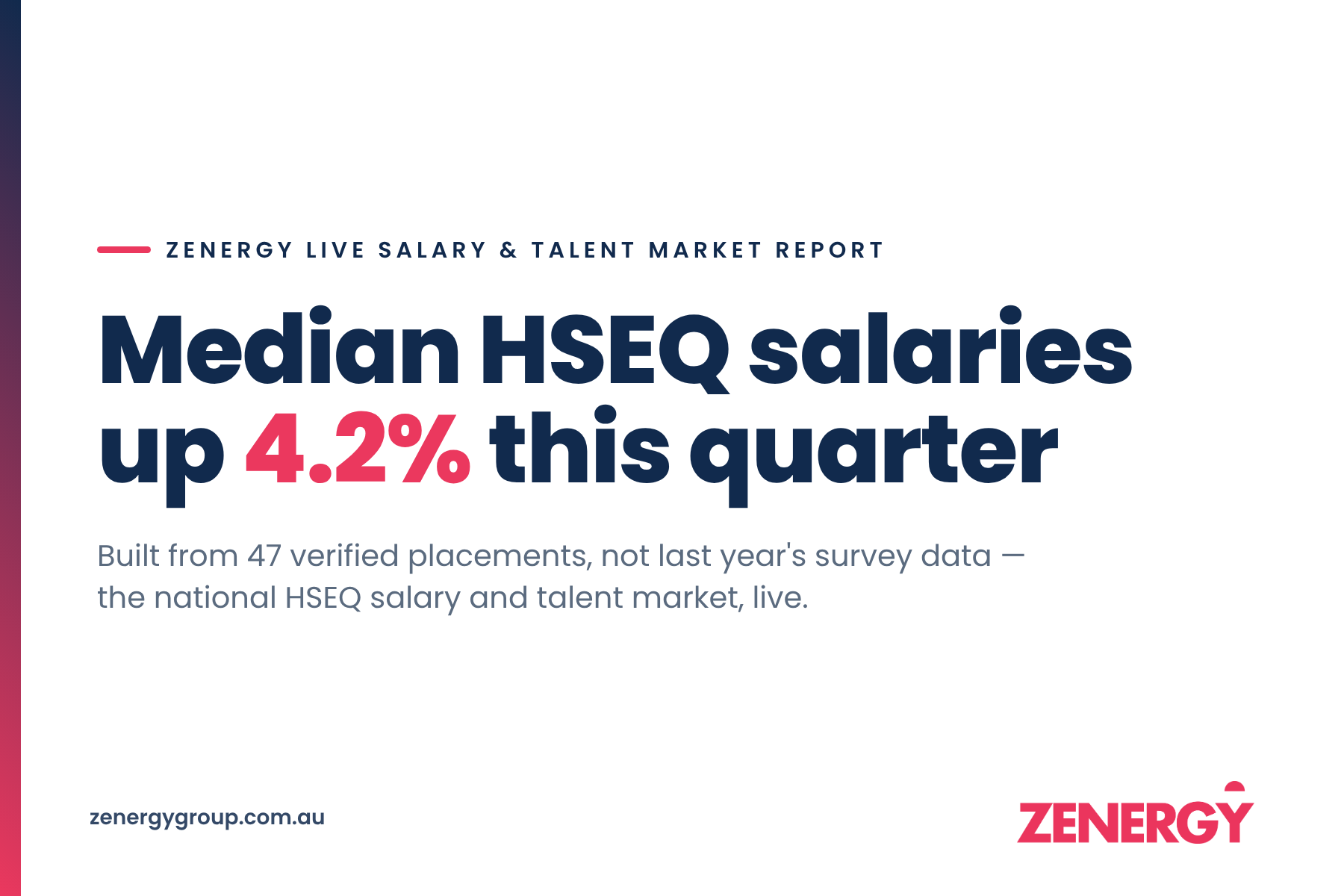
When demand increases faster than supply, remuneration becomes an important part of the recruitment conversation. Experienced HSE professionals are increasingly aware of their market value and are assessing roles based on more than the advertised salary.
For employers, this means salary benchmarking is becoming increasingly important. However, simply increasing remuneration is not always enough to secure the right person.
A competitive package may need to consider:
- Base salary
- Superannuation
- Bonuses or incentives
- Contract rates
- Flexible working arrangements
- Project duration and stability
- Career progression
- Leadership responsibility
- Location and travel requirements
- Workplace culture
The strongest candidates are often evaluating the total value of the role, rather than salary in isolation.
5. Candidate expectations have changed
The HSE professionals most in demand are becoming more selective about the roles they consider. Candidates increasingly want to understand:
What will I be responsible for?
A vague position description can make a role difficult to sell. Strong candidates want clarity around reporting lines, team structure, scope and decision-making authority.
Who will I report to?
The relationship between an HSE leader and the executive team can significantly influence how effective they can be.
Does the organisation genuinely value HSE?
Candidates can distinguish between organisations that want compliance and organisations that genuinely want to improve safety performance.
What resources will I have?
HSE professionals want to know whether they will have the people, systems, budget and leadership support required to deliver results.
Where can the role lead?
Experienced professionals are often thinking beyond their immediate position. They want to understand how the role fits into their longer-term career.
This means employers are no longer simply competing against other salaries. They are competing on the overall employee proposition.
What we're seeing at Zenergy
As a specialist HSE recruiter, Zenergy has a different view of the market from a generalist recruitment agency. We work specifically within the health, safety, environment and sustainability space, which gives us visibility across candidate movements, employer requirements and changing role expectations. Our recruitment conversations consistently highlight a few themes.
The best candidates are rarely available for long
Highly experienced HSE professionals often have multiple options when they enter the market. This means organisations that take too long to make decisions can lose candidates before the recruitment process is complete.
Technical capability is only part of the equation
Employers increasingly want people who can influence, not simply advise. The ability to communicate with operations, challenge senior stakeholders, engage workers and translate HSE requirements into practical actions is becoming increasingly important.
Industry experience matters
A candidate may be technically excellent but still not be the right fit for a particular environment. An HSE Manager moving into a major infrastructure project, for example, may need very different experience from someone supporting a manufacturing operation or a large logistics network. Understanding the environment behind the job title is therefore critical.
Speed matters
One of the biggest differences we see between successful and unsuccessful hiring processes is often decision-making speed. When a strong candidate is identified, employers need to be able to move. A lengthy process involving multiple interviews, unclear feedback or delays in approving an offer can result in candidates accepting another role.
How can employers secure HSE talent faster?
A competitive HSE recruitment market does not mean employers cannot secure strong candidates. It means the recruitment process needs to be more deliberate.
1. Define the role before going to market
Be clear about the actual problem the person needs to solve.
Instead of simply looking for an "HSE Manager", define:
- The operational environment
- Team structure
- Key risks
- Reporting relationship
- Level of autonomy
- Required industry experience
- Leadership expectations
- Immediate priorities
This allows recruiters to identify candidates based on capability rather than keywords.
2. Benchmark the remuneration package
Before launching a search, understand where the role sits in the current market. An unrealistic salary range can significantly reduce the available candidate pool and extend the time required to hire.
3. Sell the role, not just the job description
Experienced candidates are assessing employers as carefully as employers are assessing candidates. Explain why the role exists, what the person will influence and what success looks like. The strongest HSE professionals want to know that their work will have an impact.
4. Reduce unnecessary recruitment stages
A strong candidate experience can make a significant difference. Where possible, agree on the interview process before commencing the search and ensure key stakeholders are available to make decisions.
5. Consider interim or contract solutions
If the business cannot afford to leave an HSE leadership position vacant, an interim or contract professional can provide immediate capability while the permanent search continues. This can be particularly valuable for major projects, extended leave, organisational change or urgent vacancies.
6. Work with a specialist HSE recruiter
General recruitment agencies can identify candidates with HSE titles. A specialist recruiter can assess whether a candidate's actual experience matches the operational requirements of the role. At Zenergy, our focus is exclusively on HSE and related specialist roles. This allows us to understand the difference between technical qualifications, practical capability, leadership experience and sector-specific expertise.
The HSE recruitment market is becoming more competitive
Australia's HSE talent market is changing.
The challenge for employers is not simply finding someone with an HSE qualification. It is securing experienced professionals who can lead, influence, manage risk and operate effectively within the organisation's specific environment. As demand continues across infrastructure, logistics, renewables, manufacturing and other sectors, employers that rely on slow, generic recruitment processes risk losing access to the strongest candidates.
The organisations that secure HSE talent most effectively will be those that understand their requirements, move decisively and present a compelling role to the market.
Need to hire an experienced HSE professional?
Zenergy specialises in HSE recruitment across Australia, connecting organisations with experienced HSE, WHS, environmental and sustainability professionals.
Contact Zenergy on 1300 333 400 or info@zenergygroup.com.au to discuss your recruitment requirements.
Frequently Asked Questions
Why is it difficult to recruit experienced HSE Managers in Australia?
Experienced HSE Managers are difficult to recruit because demand for professionals with strong technical, leadership and industry experience is high, while the supply of candidates with this combination of skills is more limited.
Which industries are hiring HSE professionals in Australia?
Strong demand for HSE professionals exists across infrastructure, logistics, warehousing, renewables, energy, manufacturing and other high-risk operational environments.
Are HSE contract roles becoming more common?
Yes. Contract and interim HSE appointments can provide organisations with immediate specialist capability during major projects, periods of increased activity, extended vacancies or while permanent recruitment is underway.
What do HSE professionals look for in a new role?
Experienced HSE professionals commonly consider remuneration, leadership support, organisational culture, role scope, flexibility, career development, resources and the opportunity to influence safety performance.
How can employers attract experienced HSE professionals?
Employers can improve their chances by clearly defining the role, offering competitive remuneration, communicating the organisation's commitment to HSE, simplifying the recruitment process and making decisions quickly when strong candidates are identified.
Contact Us
Zenergy News