Zenergy Take 5 — week commencing 5 October 2026
Welcome to Take 5, Zenergy's weekly five-minute scan of what's moving in Australian workplace health and safety, workers compensation and people & culture — five items, one featured senior role, every source named. This week: a hard regulatory deadline lands on the calendar, Safe Work Month hits its stride, and Safe Work Australia publishes the clearest picture in years of who is actually exposed to harm at work.
1. New workplace exposure limits commence 1 December — including Australia's first diesel particulate limit
The transition period for Safe Work Australia's updated workplace exposure limits (WELs) for airborne contaminants ends on 1 December 2026. The list introduces Australia's first national exposure limit for diesel particulate matter — 0.01 mg/m³, measured as respirable elemental carbon — alongside revised limits for a range of other contaminants. Regulators are telling duty holders to use the remaining weeks to review exposure monitoring, confirm controls are effective, and prioritise elimination and engineering controls over reliance on RPE.
If your operations involve diesel plant in enclosed or poorly ventilated environments — distribution centres, tunnels, underground mining, workshops — this is the compliance item to table at your next leadership meeting. Safe Work Australia has published guidance and a transition toolkit, and state regulators including SafeWork SA have flagged the change, as has NOPSEMA for offshore operators.
Sources: Safe Work Australia — Changes to Workplace Exposure Limits (safeworkaustralia.gov.au); SafeWork SA — Get ready for new Workplace Exposure Limits (safework.sa.gov.au); NOPSEMA — Diesel engine emissions: new workplace exposure limit takes effect December 2026 (nopsema.gov.au).
2. Dates ahead: Safe Work Month's “for health” week and World Mental Health Day
National Safe Work Month is underway, with Safe Work Australia's 2026 theme “Safe work is for life” running week-by-week focuses: “for health” (week two, this week), “for the future” (week three) and “for all” (week four). World Mental Health Day falls on Saturday 10 October, inside Mental Health Month — a natural prompt to put psychological health on the toolbox agenda, not just the poster wall. Regulators are active too: SafeWork NSW opened the month with a compliance operation targeting the meat processing sector.
Sources: Safe Work Australia — National Safe Work Month (safeworkaustralia.gov.au/national-safe-work-month); SafeWork NSW — news, 1 October 2026 (safework.nsw.gov.au).
3. People & culture: FWO recovers $453 million for workers in 2025–26
The Fair Work Ombudsman's 2025–26 results, released 14 September, show $453 million recovered for underpaid workers across the year, with Ombudsman Anna Booth urging employers to find “compliance common ground”. For employers, the signal hasn't changed: payroll governance, award classification and record-keeping sit alongside WHS as enterprise-level compliance risks — and the regulator's recovery capability keeps growing. Worth a standing item on the people & culture risk register, especially for businesses with large award-covered or labour-hire workforces.
Source: Fair Work Ombudsman media release, 14 September 2026 (fairwork.gov.au/newsroom).
4. Job market pulse: national vacancies ease, HSE demand holds
The ABS's August 2026 Job Vacancies figures (released 1 October) show 325,000 vacancies nationally — down 0.9% over the quarter and 1.3% over the year, and 31.2% below the May 2022 peak. Private sector vacancies fell 2.0% for the quarter while public sector vacancies rose 7.8%. Health care and social assistance remains the deepest vacancy pool at 54,300.
Against that gently easing backdrop, safety hiring is holding its ground from WHS advisors in Melbourne manufacturing to safety leadership in Queensland logistics — a spread we read as steady, sector-broad demand for proven operators rather than a hiring spike.
Sources: ABS — Job Vacancies, Australia, August 2026 (abs.gov.au);
5. Industry story of the week: 68% of workers likely exposed to at least one hazard
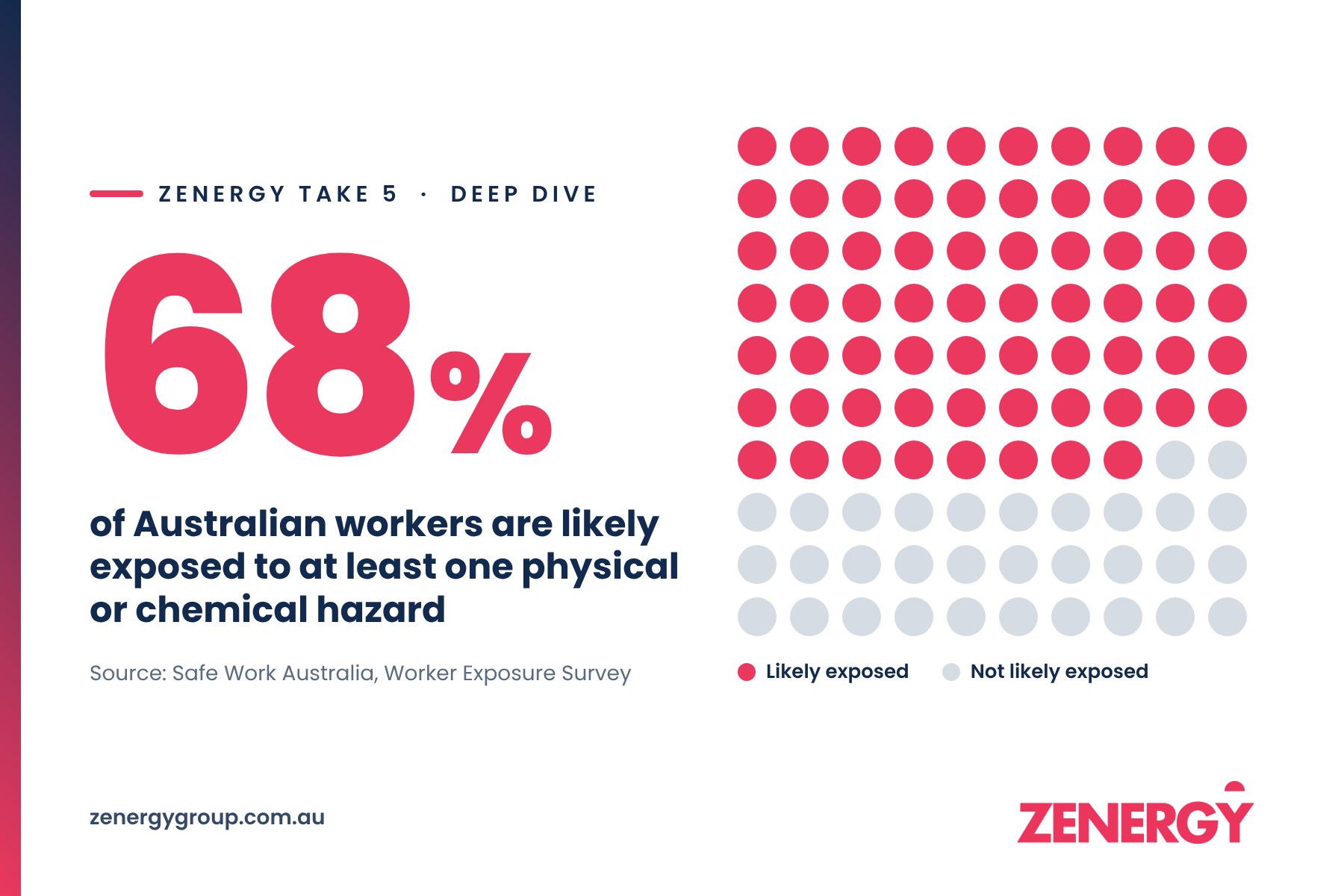
Safe Work Australia's newly published Worker Exposure Survey finds 68% of Australian workers are likely exposed to at least one physical or chemical hazard at work, with 28.9% experiencing high-level exposure. Solar UV is the most common hazard (an estimated 4.87 million workers), silica exposure covers an estimated 2.04 million workers and is heavily concentrated in construction and mining, and apprentices and trainees are disproportionately exposed across heat, silica, lead and asbestos. Construction, agriculture and mining are the industries most likely to see multiple hazard exposure.
It's the week's most important read for HSE leaders — and the subject of this week's Zenergy deep-dive, where we unpack what the numbers mean for exposure monitoring, young-worker supervision and the 1 December exposure limit deadline.
Sources: Safe Work Australia — Worker Exposure Survey (safeworkaustralia.gov.au); Safety Solutions, 28 September 2026 — “Over two-thirds exposed to a physical or chemical hazard, workers survey reveals”
Contact Us
Zenergy News