Celebrating the Australian Health & Safety Industry; congratulations to the 2026 AWHSA finalists

Most good safety work is invisible. When it's done well, nothing happens: the shift ends, the crew goes home, the worker who was injured last year is back doing the job they love. On Thursday 12 November, that work gets the spotlight it deserves.


Zenergy is proud to sponsor the 2026 Australian Workplace Health and Safety Awards (AWHSA), presented by the Australian Institute of Health & Safety (AIHS). This year 52 finalists have been named across eight categories, and we want to congratulate every one of them before the winners are announced at the gala in Sydney.


Why these awards matter


The AWHSA give national recognition to organisations and individuals showing excellence and innovation in work health and safety. They are open to any organisation operating in Australia and to individuals working in WHS, from Health and Safety Representatives on the floor to the executives setting safety strategy.


That breadth is the point. The 2026 finalist list covers hospitals and councils, mining and energy, rail and road, schools, retail and telecommunications. It shows that safety leadership is not owned by one industry or one job title. It's built by HSRs, rising professionals who bring new thinking, and industry leaders.


What stood out in this year's field


Reading through the finalists, a few themes came through clearly:


  • Psychosocial safety has moved from policy to practice. Several finalists are being recognised for psychosocial risk frameworks, capability building and programs addressing aggression and violence towards workers. That matches what we see in the market, where demand for HSE professionals with practical psychosocial and ISO 45003 experience keeps growing.
  • Engineering out critical risk. The Technology & Innovation finalists include collision avoidance, lifting programs and purpose-built protection frames: controls at the top of the hierarchy, not the bottom.
  • Recovery and return to work as a core safety outcome. The Recovery & Return to Work category recognises teams who treat getting people back to good work as part of safety, not an afterthought.
  • Frontline-led capability. Training finalists are building critical-risk and wellbeing capability from apprentices up, delivered at scale.


Congratulations to the 2026 finalists


HSR of the Year: Paul Cooper (Gold Coast Hospital and Health Services), Meti Kitai (Cleanaway), Emanuel Mason (City of Ballarat).


WHS Rising Star: Joemike Almoguera (M80 Ring Road Completion), Dylan Cubitt (Skilltech, a Downer Company), Rachael Franich (Downer Energy & Utilities), Ciara Freeman (Melbourne Park), Ben Mann (St John WA), Rachel Marlais (BMD), Amy Nicholas.


WHS Leader of the Year (fewer than 1,000 employees): Josh Bryant (Mitchell Services), Joel Chan (Minprovise International), Rick Najar (VIDA Rail), Laurie Naveaux (Komatsu), Andrew Pachioli (ADCO Constructions), Peter Westbrook (Gilbarco Veeder-Root Australia).


WHS Leader of the Year (more than 1,000 employees): Tim Allred (Downer Energy & Utilities), Louise Belcher (bp Australia), Brian Gallop (St John WA), Rachel Jones (Fortescue), Adam Keddad (AGL Energy), Caitlin Seaha (Downer Group).


Best Recovery & Return to Work: Essential Energy, Fortescue, Gilbarco Veeder-Root Australia, Gold Coast Hospital and Health Service, Jemena/Zinfra Group (Zinfra Injury Management Team), Workplace Health and Safety by Altius.


Best Health & Wellbeing Strategy: Brisbane Catholic Education, Brisbane Grammar School, Built, Elecnor Australia, Marinus Link, NGM Group.


Best WHS Training & Development: EM Community of Practice, Levande, Komatsu Australia, Downer Group, Vodafone, AGL Energy.


Best WHS Technology & Innovation: BMD Group, City of Moreton Bay, Downer Energy & Utilities, Fortescue, McConnell Dowell, Spa Electrics.


WHS Team of the Year: BHP (Carrapateena), BMD Group, Downer (SICS), Ferrovial Gamuda Joint Venture (Coffs Harbour Bypass), St John WA, Woolworths Group (AOVA Squad).


To every finalist, and to the colleagues who nominated you: well done. Making the shortlist at a national level is a real achievement, whatever happens on the night.


Our role as an industry partner


Zenergy has worked alongside Australia's health and safety profession since 2006. Over 20 years we've placed more than 2,400 WHS professionals in permanent roles and filled more than 1,100 contract assignments, and we're proud to have been a founding partner of these Awards. Supporting the AWHSA is one of the most direct ways we can give back to the profession that has built our business.


"Every year the finalists remind us why this profession matters. These are people who protect their colleagues, lift their teams and lead change in their organisations. Zenergy is proud to stand beside them, and beside AIHS, in recognising that work." — Dean Woods, Managing Director, Zenergy

Our partnership with AIHS goes beyond the gala. Through 2026 we've worked together on networking events, industry content and leadership events that bring safety professionals together across the country.


Join us on the night


The 2026 gala is on Thursday 12 November, 6:30pm to 11:30pm, at The Heritage Wharf, Jones Bay Wharf, Pyrmont. It's cocktail attire, with drinks on the wharf, dinner and the awards, then the dance floor. Tickets are available through AIHS: register here.


We look forward to celebrating with the finalists, their teams and the wider safety community. See you on the wharf.


Talk to Zenergy

Building a team that could be on next year's finalist list? Whether you need a permanent HSE leader, an executive search, or interim support to keep a critical program moving, our specialist consultants can help. Call 1300 333 400 or email info@zenergygroup.com.au for a confidential conversation.

Contact Us

Zenergy News
By Dean Woods • October 13, 2026
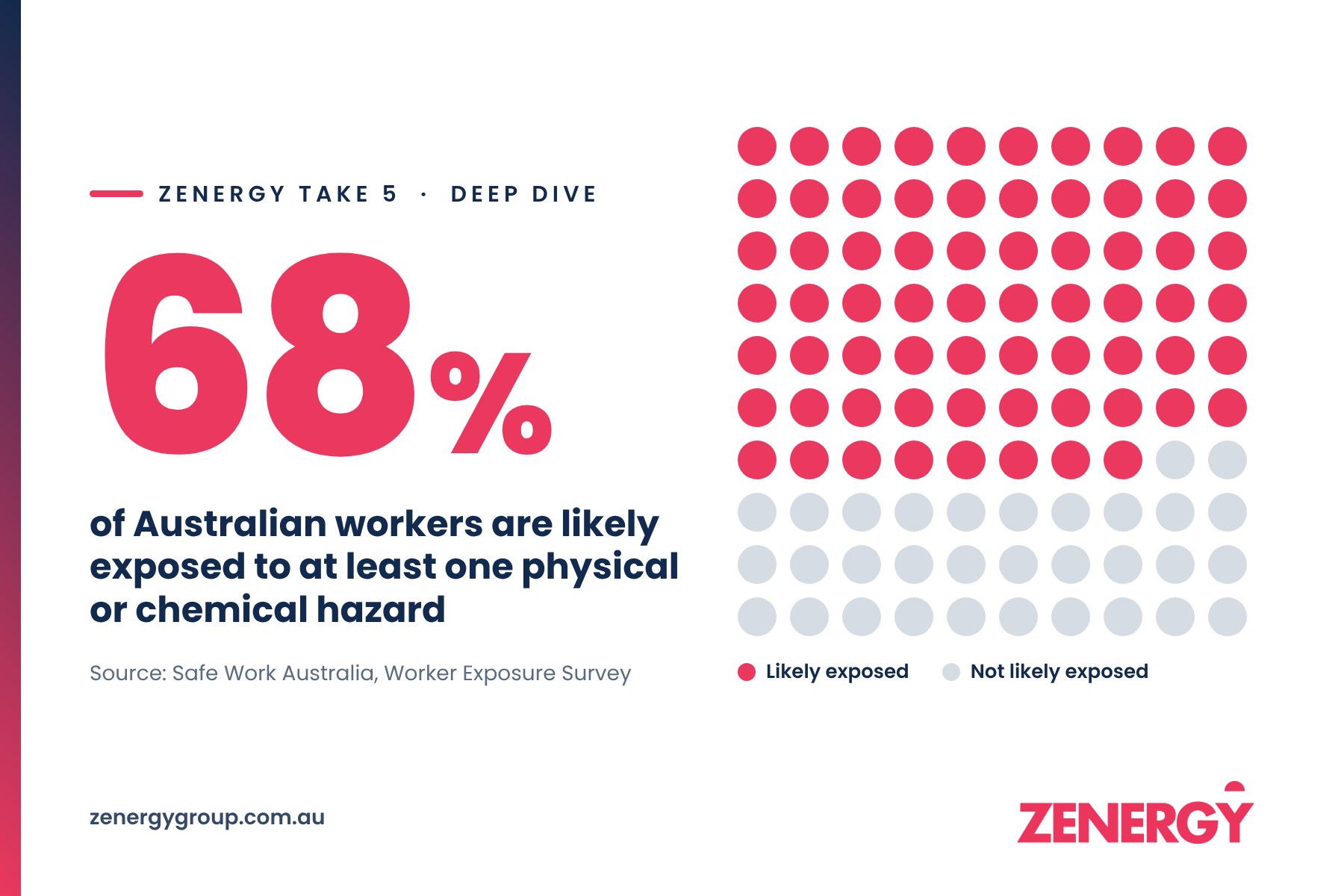
Welcome to Take 5, Zenergy's weekly five-minute scan of what's moving in Australian workplace health and safety, workers compensation and people & culture — five items, one featured senior role, every source named. This week: a hard regulatory deadline lands on the calendar, Safe Work Month hits its stride, and Safe Work Australia publishes the clearest picture in years of who is actually exposed to harm at work. 1. New workplace exposure limits commence 1 December — including Australia's first diesel particulate limit The transition period for Safe Work Australia's updated workplace exposure limits (WELs) for airborne contaminants ends on 1 December 2026. The list introduces Australia's first national exposure limit for diesel particulate matter — 0.01 mg/m³, measured as respirable elemental carbon — alongside revised limits for a range of other contaminants. Regulators are telling duty holders to use the remaining weeks to review exposure monitoring, confirm controls are effective, and prioritise elimination and engineering controls over reliance on RPE. If your operations involve diesel plant in enclosed or poorly ventilated environments — distribution centres, tunnels, underground mining, workshops — this is the compliance item to table at your next leadership meeting. Safe Work Australia has published guidance and a transition toolkit, and state regulators including SafeWork SA have flagged the change, as has NOPSEMA for offshore operators. Sources: Safe Work Australia — Changes to Workplace Exposure Limits (safeworkaustralia.gov.au); SafeWork SA — Get ready for new Workplace Exposure Limits (safework.sa.gov.au); NOPSEMA — Diesel engine emissions: new workplace exposure limit takes effect December 2026 (nopsema.gov.au). 2. Dates ahead: Safe Work Month's “for health” week and World Mental Health Day National Safe Work Month is underway, with Safe Work Australia's 2026 theme “Safe work is for life” running week-by-week focuses: “for health” (week two, this week), “for the future” (week three) and “for all” (week four). World Mental Health Day falls on Saturday 10 October, inside Mental Health Month — a natural prompt to put psychological health on the toolbox agenda, not just the poster wall. Regulators are active too: SafeWork NSW opened the month with a compliance operation targeting the meat processing sector. Sources: Safe Work Australia — National Safe Work Month (safeworkaustralia.gov.au/national-safe-work-month); SafeWork NSW — news, 1 October 2026 (safework.nsw.gov.au). 3. People & culture: FWO recovers $453 million for workers in 2025–26 The Fair Work Ombudsman's 2025–26 results, released 14 September, show $453 million recovered for underpaid workers across the year, with Ombudsman Anna Booth urging employers to find “compliance common ground”. For employers, the signal hasn't changed: payroll governance, award classification and record-keeping sit alongside WHS as enterprise-level compliance risks — and the regulator's recovery capability keeps growing. Worth a standing item on the people & culture risk register, especially for businesses with large award-covered or labour-hire workforces. Source: Fair Work Ombudsman media release, 14 September 2026 (fairwork.gov.au/newsroom). 4. Job market pulse: national vacancies ease, HSE demand holds The ABS's August 2026 Job Vacancies figures (released 1 October) show 325,000 vacancies nationally — down 0.9% over the quarter and 1.3% over the year, and 31.2% below the May 2022 peak. Private sector vacancies fell 2.0% for the quarter while public sector vacancies rose 7.8%. Health care and social assistance remains the deepest vacancy pool at 54,300. Against that gently easing backdrop, safety hiring is holding its ground from WHS advisors in Melbourne manufacturing to safety leadership in Queensland logistics — a spread we read as steady, sector-broad demand for proven operators rather than a hiring spike. Sources: ABS — Job Vacancies, Australia, August 2026 (abs.gov.au); 5. Industry story of the week: 68% of workers likely exposed to at least one hazard Safe Work Australia's newly published Worker Exposure Survey finds 68% of Australian workers are likely exposed to at least one physical or chemical hazard at work, with 28.9% experiencing high-level exposure. Solar UV is the most common hazard (an estimated 4.87 million workers), silica exposure covers an estimated 2.04 million workers and is heavily concentrated in construction and mining, and apprentices and trainees are disproportionately exposed across heat, silica, lead and asbestos. Construction, agriculture and mining are the industries most likely to see multiple hazard exposure. It's the week's most important read for HSE leaders — and the subject of this week's Zenergy deep-dive, where we unpack what the numbers mean for exposure monitoring, young-worker supervision and the 1 December exposure limit deadline. Sources: Safe Work Australia — Worker Exposure Survey (safeworkaustralia.gov.au); Safety Solutions, 28 September 2026 — “Over two-thirds exposed to a physical or chemical hazard, workers survey reveals”
By Dean Woods • October 7, 2026
Safe Work Australia's Worker Exposure Survey finds 68% of workers exposed to hazards. What HSE leaders should do before new limits land on 1 Dec.
City skyline at sunset with tall modern buildings under a colorful orange and blue sky
September 16, 2026
Explore the latest Safe Work Australia updates for 2026, including WHS penalties, incident notification, AI, chemical exposure limits and regulatory changes.
Worker in white hard hat and glasses speaking on a factory floor, with colleagues blurred in the background
September 9, 2026
Should you hire an HSE contractor or permanent HSE Manager? Explore when interim HSE solutions make sense for Australian businesses, projects and temporary vacancies.
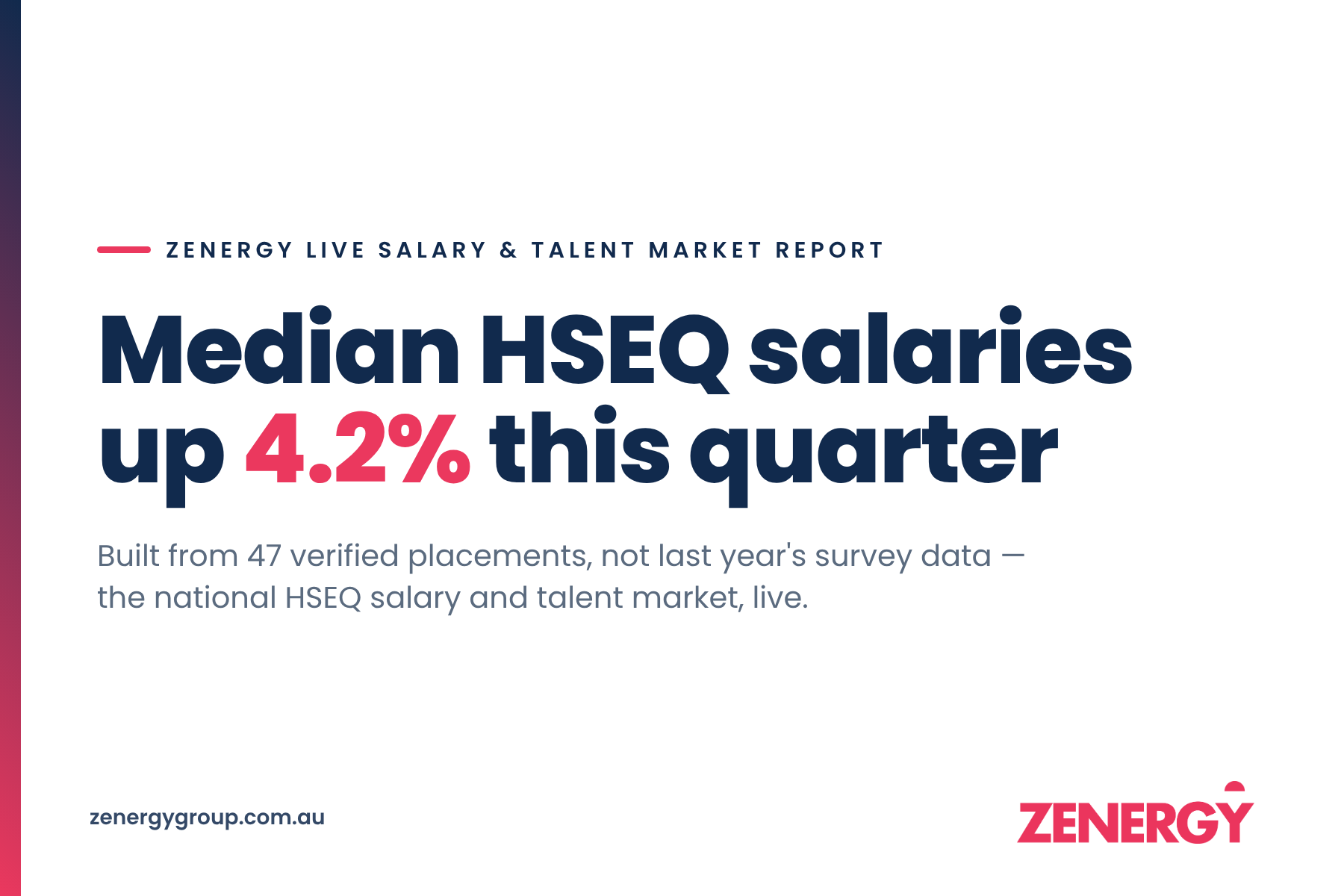
HSEQ salary bands by role, Australia Q4 FY2026 – Zenergy
By Dean Woods • September 7, 2026
See live HSEQ salary data from 47 verified Zenergy placements — HSE Manager, WHS Advisor and Head of HSEQ pay bands, by city and company size.
Worker in a yellow hard hat and orange jacket at an industrial site, seen from behind.
September 2, 2026
Why is HSE recruitment becoming harder in Australia? Zenergy shares 2026 insights on HSE talent shortages, contract hiring, salaries and candidate expectations.
More Posts