
Zenergy Leaders Forum: WHS Legislative and Industry Update — Leading the Future of Safe Work

Zenergy proudly hosted the Zenergy Leaders Forum: WHS Legislative and Industry Update in Sydney — bringing together industry leaders, government representatives, and workplace safety professionals for an insightful discussion on the evolving landscape of Workplace Health and Safety in Australia.


The event provided a platform for collaboration and forward-thinking dialogue between policy-makers, regulators, legal experts, and business leaders. With workplaces adapting to new challenges, the forum reinforced one key message: creating safer, healthier, and more sustainable organisations requires leadership, accountability, and shared commitment.
A Vision for Safer, Fairer Workplaces

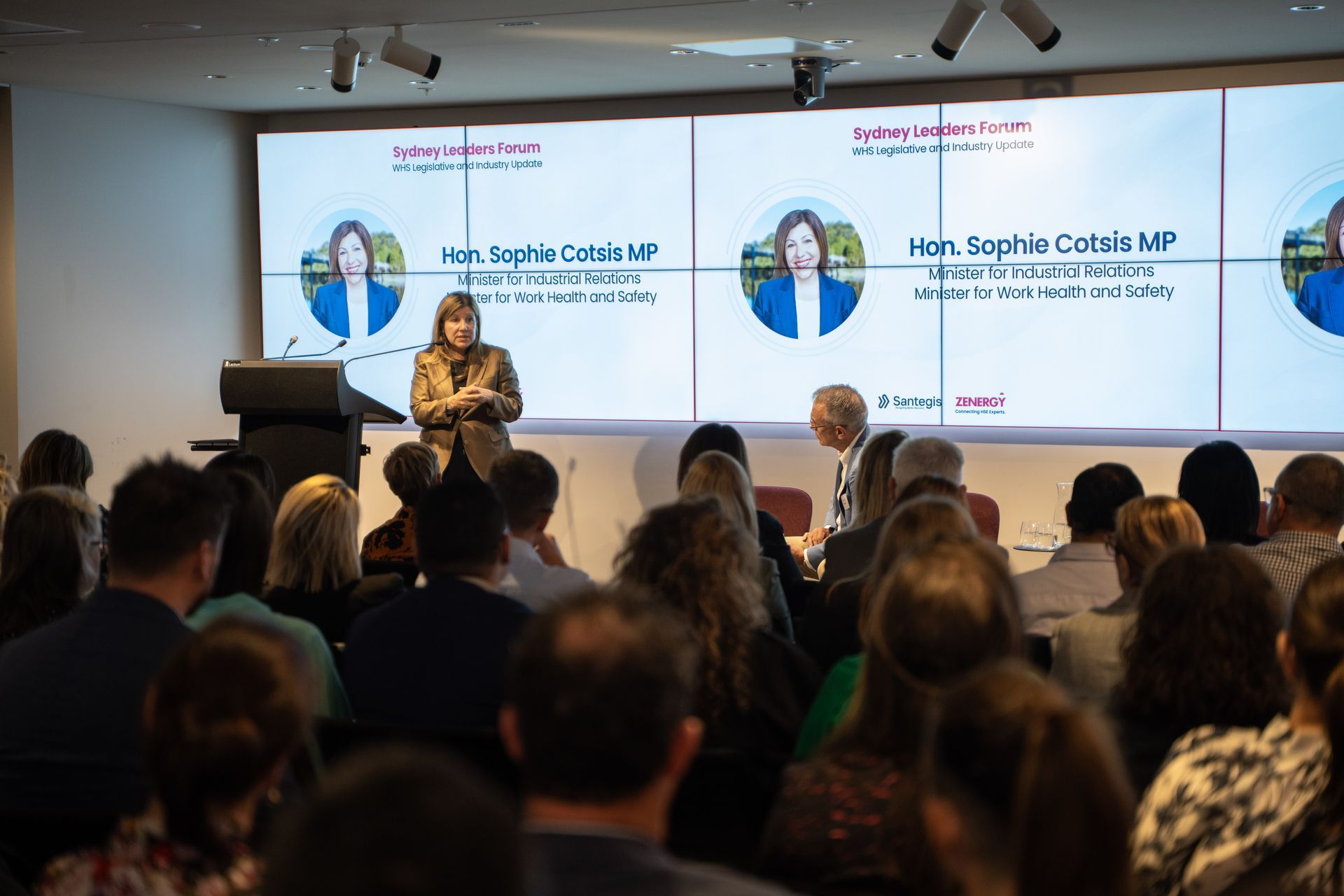
The forum opened with a keynote address by Hon. Sophie Cotsis MP, Minister for Industrial Relations and Minister for Work Health and Safety.

Minister Cotsis outlined the NSW Government’s renewed focus on ensuring that every worker — across every industry — returns home safely each day. She spoke about the government’s commitment to reform, collaboration, and stronger enforcement, highlighting new legislative priorities designed to enhance fairness, accountability, and wellbeing in Australian workplaces.


“Safety isn’t negotiable — it’s about care, respect, and leadership,” Minister Cotsis said. “When businesses lead with safety, they lead with integrity.”


Her remarks set the tone for a day centred on connection — between policy and practice, leadership and accountability, and people and purpose.


Panel Discussion: The Changing Face of Workplace Health and Safety

Moderated by David Ninnes, Group Head of Accountability at Westpac Group, and John Lee, Independent Director,  the panel brought together leading voices shaping the future of safety in Australia:


Together, they explored the current Workplace Health and Safety landscape and what’s next for organisations navigating legislative change, psychosocial safety, and cultural transformation.


1. Emerging Safety Priorities

The panel discussed the growing complexity of safety in modern workplaces — from managing psychosocial risks to embedding mental health into safety systems. The conversation highlighted the shift from reactive compliance to proactive leadership, where organisations are expected to lead cultural change rather than simply follow regulation.


Angela Wallbank noted that psychosocial safety is now integral to business performance, not just compliance. Janet Schorer emphasised SafeWork NSW’s focus on education and enforcement, encouraging leaders to create psychologically safe environments where people can raise concerns without fear.


2. Legislative Reform and Accountability

Katherine Morris provided a legal perspective on recent and upcoming WHS changes, including industrial manslaughter provisions, harmonisation between states, and the importance of board-level accountability.


She noted that regulators are increasingly focused on leadership responsibility, with directors expected to demonstrate active oversight of safety systems. John Lee added that this shift is also cultural: “The best leaders aren’t waiting for enforcement — they’re taking ownership of safety as a core value.”


The discussion underscored that compliance and culture must evolve together — with leaders at all levels taking responsibility for shaping safer, more transparent workplaces.


3. From Compliance to Culture

One of the strongest themes throughout the discussion was the human side of safety. As workplaces become more complex, success depends on empowering people — not just implementing processes.


The panellists agreed that psychological safety and trust are now critical performance indicators. Leaders must not only model safe behaviour but also listen, engage, and support their teams in meaningful ways. When safety becomes part of the organisational DNA, engagement and performance naturally follow.


A Platform for Collaboration and Change

The Zenergy Leaders Forum highlighted the importance of collaboration between government, regulators, and business. It also showcased how Zenergy are driving these connections — creating platforms for open discussion, knowledge sharing, and collective problem-solving.


For Zenergy, this event was an extension of our mission: to connect people and culture to safer, healthier, and more sustainable outcomes. We remain committed to supporting organisations in translating policy into practice — through leadership development, HSE consulting, and workforce solutions.


Key Takeaways

  • Leadership accountability is non-negotiable. Directors and executives must actively engage in safety governance.
  • Psychosocial safety is the next frontier. Addressing psychological risk is central to sustainable business performance.
  • Policy and practice must align. Collaboration between regulators and industry remains vital for real progress.
  • Culture drives safety. Empowering workers to speak up and be part of the solution creates lasting change.
  • Partnerships build impact. Forums like this unite the WHS community to shape the future of safe and healthy work.


Looking Ahead

As the Workplace Health and Safety landscape continues to evolve, the call for stronger leadership, collaboration, and accountability grows louder. The Zenergy Leaders Forum served as a reminder that safety is everyone’s responsibility — and that meaningful change begins with connection.


Zenergy thanks all speakers, attendees, and partners for contributing to an inspiring and insightful event.


To stay informed about upcoming forums and insights in Workplace Health and Safety, visit zenergygroup.com.au or follow Zenergy on LinkedIn.


Contact Us

Zenergy News

WHS news Australia
By Dean Woods • October 25, 2026
This week: the Best Practice Review of the model WHS laws, new Clerks Award work-from-home rules, job market data and a featured Sydney HSE Manager role.
Best Practice Review model WHS laws
By Dean Woods • October 25, 2026
Safe Work Australia's first national WHS review since 2018 makes 21 recommendations. What they cover and what HSE leaders should do before they become law.
Fake Safety Certificates: An HSE Hiring Wake-Up Call
By Dean Woods • October 19, 2026
WorkSafe Victoria is investigating fake safety qualifications. How employers should verify tickets, licences and real competency when hiring HSE talent.
Zenergy Take 5: WHS News for the Week of 19 October 2026
By Dean Woods • October 19, 2026
Queensland’s psych injury claims shake-up, fake safety certificates under investigation, fresh job market data and this week’s featured HSE role.
Zenergy Congratulates the 2026 AWHSA Finalists
By Dean Woods • October 13, 2026
Zenergy is proud to sponsor the 2026 Australian Workplace Health & Safety Awards. Meet the 52 finalists ahead of the Sydney gala on 12 November.
By Dean Woods • October 13, 2026
Welcome to Take 5, Zenergy's weekly five-minute scan of what's moving in Australian workplace health and safety, workers compensation and people & culture — five items, one featured senior role, every source named. This week: a hard regulatory deadline lands on the calendar, Safe Work Month hits its stride, and Safe Work Australia publishes the clearest picture in years of who is actually exposed to harm at work. 1. New workplace exposure limits commence 1 December — including Australia's first diesel particulate limit The transition period for Safe Work Australia's updated workplace exposure limits (WELs) for airborne contaminants ends on 1 December 2026. The list introduces Australia's first national exposure limit for diesel particulate matter — 0.01 mg/m³, measured as respirable elemental carbon — alongside revised limits for a range of other contaminants. Regulators are telling duty holders to use the remaining weeks to review exposure monitoring, confirm controls are effective, and prioritise elimination and engineering controls over reliance on RPE. If your operations involve diesel plant in enclosed or poorly ventilated environments — distribution centres, tunnels, underground mining, workshops — this is the compliance item to table at your next leadership meeting. Safe Work Australia has published guidance and a transition toolkit, and state regulators including SafeWork SA have flagged the change, as has NOPSEMA for offshore operators. Sources: Safe Work Australia — Changes to Workplace Exposure Limits (safeworkaustralia.gov.au); SafeWork SA — Get ready for new Workplace Exposure Limits (safework.sa.gov.au); NOPSEMA — Diesel engine emissions: new workplace exposure limit takes effect December 2026 (nopsema.gov.au). 2. Dates ahead: Safe Work Month's “for health” week and World Mental Health Day National Safe Work Month is underway, with Safe Work Australia's 2026 theme “Safe work is for life” running week-by-week focuses: “for health” (week two, this week), “for the future” (week three) and “for all” (week four). World Mental Health Day falls on Saturday 10 October, inside Mental Health Month — a natural prompt to put psychological health on the toolbox agenda, not just the poster wall. Regulators are active too: SafeWork NSW opened the month with a compliance operation targeting the meat processing sector. Sources: Safe Work Australia — National Safe Work Month (safeworkaustralia.gov.au/national-safe-work-month); SafeWork NSW — news, 1 October 2026 (safework.nsw.gov.au). 3. People & culture: FWO recovers $453 million for workers in 2025–26 The Fair Work Ombudsman's 2025–26 results, released 14 September, show $453 million recovered for underpaid workers across the year, with Ombudsman Anna Booth urging employers to find “compliance common ground”. For employers, the signal hasn't changed: payroll governance, award classification and record-keeping sit alongside WHS as enterprise-level compliance risks — and the regulator's recovery capability keeps growing. Worth a standing item on the people & culture risk register, especially for businesses with large award-covered or labour-hire workforces. Source: Fair Work Ombudsman media release, 14 September 2026 (fairwork.gov.au/newsroom). 4. Job market pulse: national vacancies ease, HSE demand holds The ABS's August 2026 Job Vacancies figures (released 1 October) show 325,000 vacancies nationally — down 0.9% over the quarter and 1.3% over the year, and 31.2% below the May 2022 peak. Private sector vacancies fell 2.0% for the quarter while public sector vacancies rose 7.8%. Health care and social assistance remains the deepest vacancy pool at 54,300. Against that gently easing backdrop, safety hiring is holding its ground from WHS advisors in Melbourne manufacturing to safety leadership in Queensland logistics — a spread we read as steady, sector-broad demand for proven operators rather than a hiring spike. Sources: ABS — Job Vacancies, Australia, August 2026 (abs.gov.au); 5. Industry story of the week: 68% of workers likely exposed to at least one hazard Safe Work Australia's newly published Worker Exposure Survey finds 68% of Australian workers are likely exposed to at least one physical or chemical hazard at work, with 28.9% experiencing high-level exposure. Solar UV is the most common hazard (an estimated 4.87 million workers), silica exposure covers an estimated 2.04 million workers and is heavily concentrated in construction and mining, and apprentices and trainees are disproportionately exposed across heat, silica, lead and asbestos. Construction, agriculture and mining are the industries most likely to see multiple hazard exposure. It's the week's most important read for HSE leaders — and the subject of this week's Zenergy deep-dive, where we unpack what the numbers mean for exposure monitoring, young-worker supervision and the 1 December exposure limit deadline. Sources: Safe Work Australia — Worker Exposure Survey (safeworkaustralia.gov.au); Safety Solutions, 28 September 2026 — “Over two-thirds exposed to a physical or chemical hazard, workers survey reveals”
More Posts