WFH reforms come with safety duties & home set-up costs
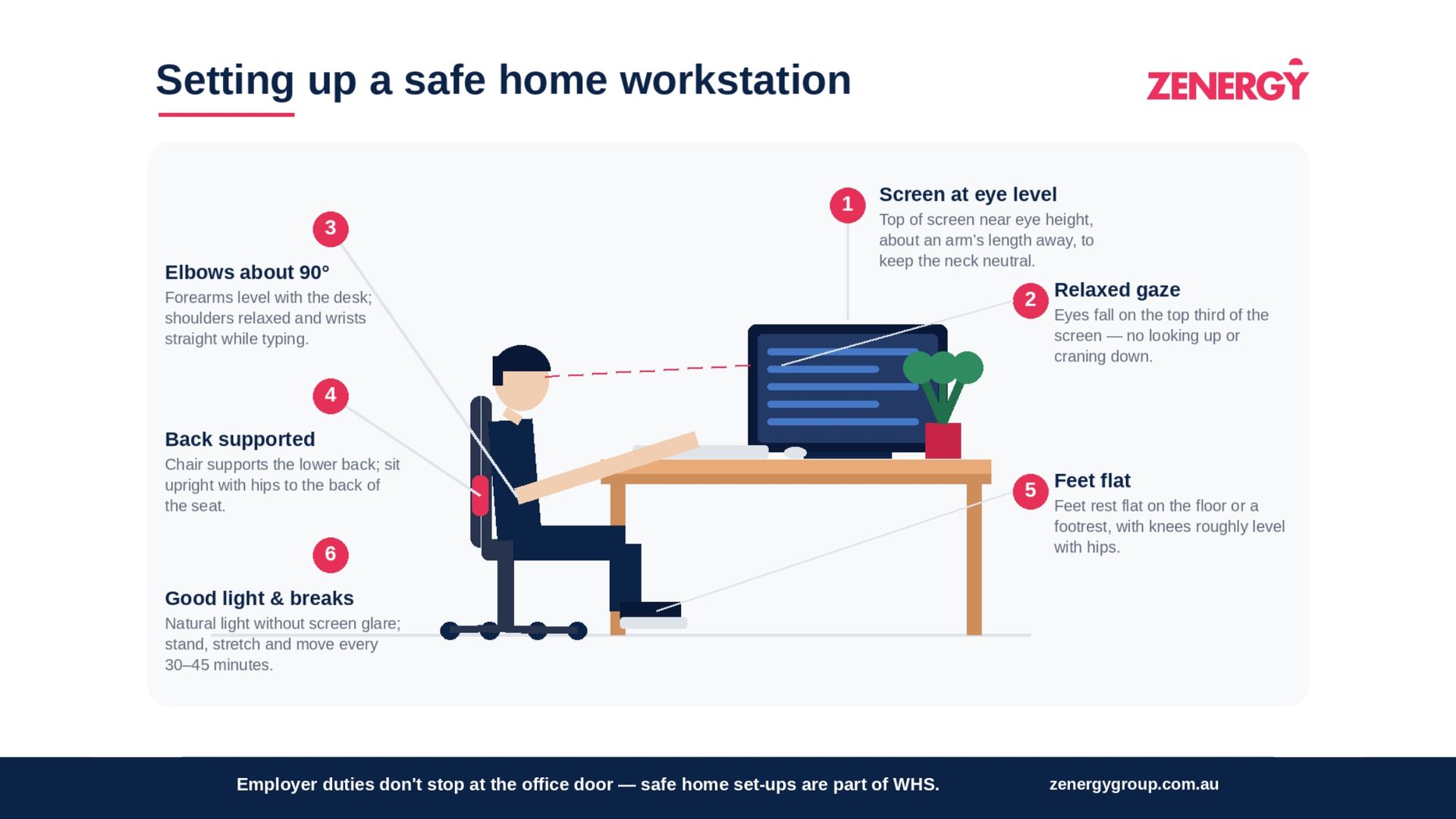
Employers have been reminded that they will be legally obligated to ensure the home workspaces of employees exercising their new work-from-home (WFH) rights are safe and healthy. Meanwhile, a senior workplace relations and safety lawyer has warned that the duty to provide "essential equipment" to these workers could become an area of dispute.
As reported by OHS Alert yesterday, the Victorian Government introduced the Equal Opportunity Amendment (Work from Home) Bill 2026 to enshrine the right for workers to work from home at least two days per week, where it is reasonable to do so (see related article).
Premier Jacinta Allan subsequently clarified to Parliament that the Bill, if passed, will not alter the operation of the State Occupational Health and Safety Act 2004, which requires employers to provide their workers with working environments that are safe and without risks to health, so far as is reasonably practicable.
These obligations apply to employees working from home and will continue to do so under the expanded WFH rights, she stressed.
She also said that workers' compensation laws similarly apply to remote work and will continue to apply in the same way under the changes.
According to the Premier, the main purpose of the Bill, which amends the Victorian Equal Opportunity Act 2010, is to protect employees from "unreasonable refusals" from WFH requests.
Under the reforms, she said, an employer assessing the reasonableness for a worker's WFH application should consider whether:
- the inherent requirements of the worker's role can be performed remotely or require in-person workplace attendance;
- the worker can only undertake the inherent requirements of their role using workplace-based equipment;
- the inherent requirements of the person's role require in-person interactions with clients, customers or members of the public;
- the impact of allowing the WFH request would be likely to result in a significant loss of productivity or efficiency;
- allowing the worker to work from home would have a significant adverse impact on safety, supervision requirements, relationship building, confidentiality and data protection, and similar matters;
- the financial cost of implementing the WFH arrangement would be excessive; and
- implementing the arrangement would force impractical changes to the working arrangements of other employees or require the recruitment of new staff.
Importantly, the Premier noted that employers will have the power to determine the specific days of the week that a worker works from home under the new provisions.
Lawyer looks at likely areas of dispute
Commenting on the proposed reforms, Holding Redlich managing partner Charles Power outlined a number of practical considerations for employers, including around the obligation, in the Bill, for businesses to cover the "reasonable costs" of eligible employees setting up their WFH spaces.
The Bill defines reasonable costs as including the costs of "essential equipment (such as hardware and software", and "secure access to the employer's information systems".
Power said the "scope of those obligations" could become an area of dispute "where there is disagreement about what equipment, software or system access is reasonably necessary to enable an employee to work remotely".
But the workplace relations and safety lawyer said that some of the most contested issues are likely to be around who qualifies for the WFH entitlement and where employers can reasonably limit it.
Those questions will, where necessary, be resolved through the Victorian Civil and Administrative Tribunal, whose "workload is set for an increase after the scheme commences on 1 September", he said.
"A feature of the Bill is that employees who are already eligible to request flexible working arrangements under the [Commonwealth Fair Work Act 2009] and wish to do so would be excluded from the Victorian entitlement," Power added.
"That creates the prospect of different work-from-home rights applying to employees within the same workplace depending on their personal circumstances," he said.
"Employers may need to navigate different eligibility requirements and different dispute resolution pathways under the Victorian and Federal regimes."
This article has been reproduced with permission from OHS Alert, and the original version appears at www.ohsalert.com.au
Contact Us
Zenergy News