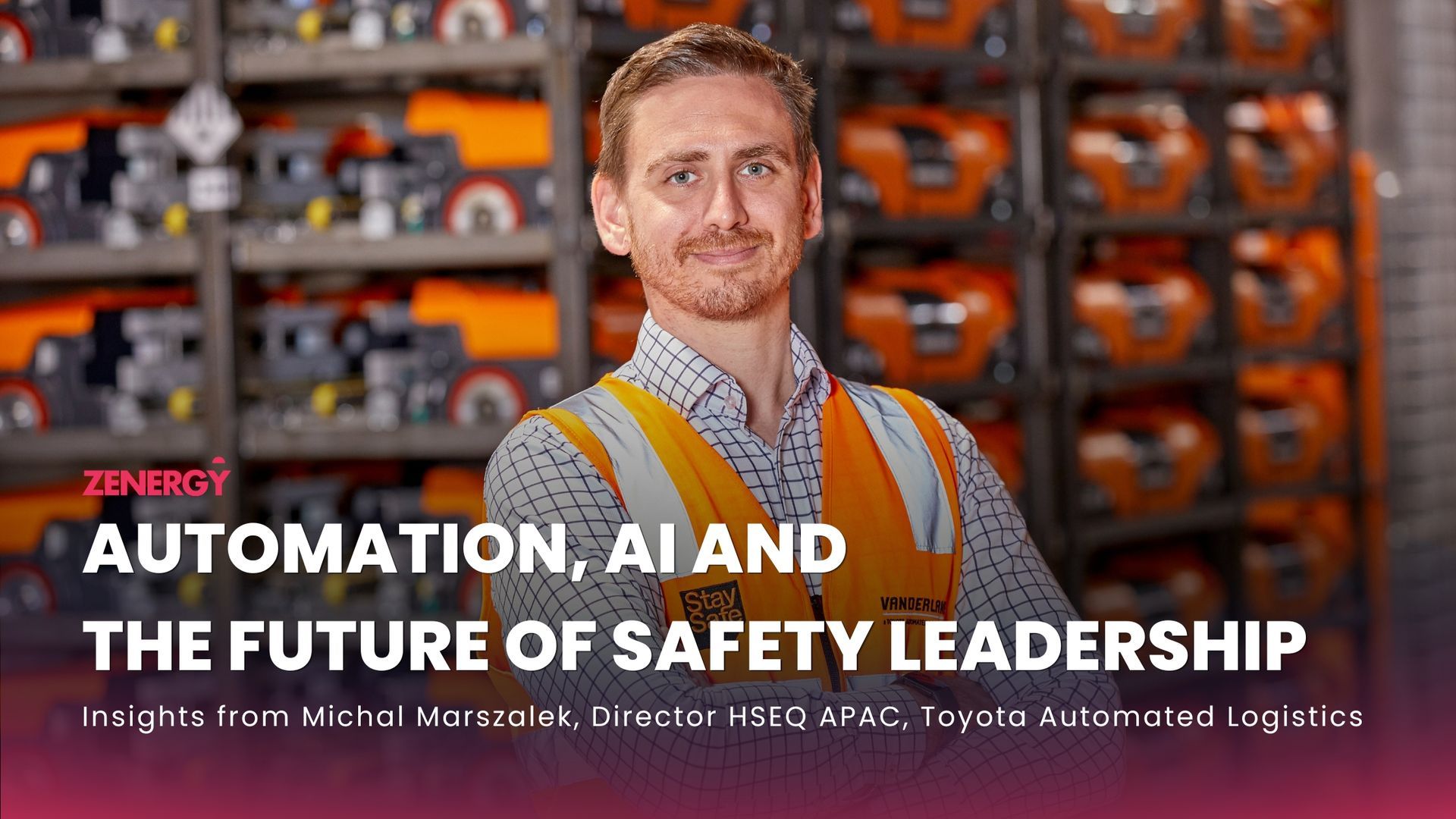
Automation, AI and the Future of Safety Leadership: Insights from Michal Marszalek, Director HSEQ APAC, Toyota Automated Logistics
Automation, artificial intelligence and robotics are transforming industries at an unprecedented pace. From automated warehouses and logistics systems to AI-assisted operational decision-making, organisations are increasingly relying on technology to improve efficiency, productivity and safety.
Yet as technology evolves, so too do the risks.
For safety leaders, the challenge is no longer simply managing traditional workplace hazards. It is understanding how people, technology, governance and culture interact within increasingly complex systems.
Michal Marszalek, Director HSEQ APAC at Toyota Automated Logistics, sits at the forefront of this evolution. Leading health, safety, environment and quality across major automation projects throughout the Asia-Pacific region, Michal works across the full lifecycle of highly automated systems, from design and engineering through to commissioning, operations and long-term maintenance.
We spoke with Michal about safety by design, the role of culture in successful automation projects, accountability in AI-driven environments and how the WHS profession is evolving alongside technology.
Safety in a World of Automation
Rather than viewing automation as a replacement for traditional safety management, Michal sees it as an opportunity to rethink how risk is managed across an asset's entire lifecycle.
Large-scale automation projects introduce complex interactions between people, robotics, software, machinery and construction activities. As a result, safety must be considered from the earliest stages of planning and design through to operation and maintenance.
For Michal, the most effective organisations are those that embed safety into decision-making from day one rather than treating it as a compliance exercise after systems have been built.
"Safety needs to be considered at every stage, not treated as a standalone compliance activity."
This requires close collaboration between engineering teams, project leaders, operations personnel, customers and contractors to ensure risk management remains integrated throughout the project lifecycle.
Why Safety by Design Matters More Than Ever
As automation systems become more sophisticated, the concept of safety by design has moved from a desirable principle to a business necessity.
According to Michal, safety by design means integrating risk management into engineering decisions from the outset. In automated environments, this extends beyond physical controls to include software interlocks, emergency systems, diagnostics, redundancy measures and human-machine interfaces.
The goal is not simply compliance. It is creating systems that are intuitive, maintainable and resilient under real operating conditions.
Importantly, Michal believes innovation should simplify safety rather than add complexity.
"The best automated systems are the ones where safe operation is engineered into the normal way of working."
Effective governance plays a critical role in achieving this. Toyota Automated Logistics incorporates multidisciplinary design safety reviews involving engineering, operations and safety specialists, while actively engaging end users during the design process.
Their practical insights often identify opportunities to improve both safety and operational performance long before a system reaches commissioning.
Automation is a Cultural Transformation
One of the strongest themes to emerge from our conversation was the importance of culture.
While discussions around automation often focus on technology, Michal believes many organisations underestimate the cultural change required to successfully implement automated systems.
A common mistake is assuming automation automatically removes risk. While technology can reduce exposure to certain hazards, it also introduces new risks, particularly during maintenance, fault finding, testing and non-routine operations where human interaction remains essential.
Organisations must ensure their operational capability evolves alongside their technology.
This includes developing competency frameworks, investing in training, strengthening leadership capability and ensuring workers understand how to interact safely with increasingly complex systems.
"Cultural readiness must develop in parallel with technological readiness."
This challenge extends beyond individual organisations. Michal notes that successful automation projects rely on strong alignment between clients, contractors and technology integrators.
Without alignment on values, risk appetite and ways of working, even technically robust systems can struggle to deliver their intended outcomes.
Accountability in the Age of AI
As AI becomes increasingly integrated into workplace systems, questions around accountability continue to grow.
Recent legislative developments in New South Wales reinforce an important principle: work must be safe whether it is directed by humans or algorithms. Organisations remain accountable for the safety of their systems regardless of the technology involved.
For Michal, this highlights the need for stronger governance frameworks around automated decision-making.
As AI plays a greater role in operational environments, organisations will need greater transparency, validation, testing and oversight of algorithm-driven systems.
There will also be increasing focus on how automated decisions influence worker behaviour, operational pressures and organisational risk.
Rather than replacing human judgement, AI will require stronger collaboration between safety professionals, engineers and business leaders to ensure innovation remains aligned with safe and ethical outcomes.
The Next Generation of Safety Leaders
The rapid growth of automation is also reshaping the WHS profession itself.
According to Michal, future safety leaders will need capabilities that extend well beyond traditional compliance and risk management.
A stronger understanding of engineering systems, automation, human factors, data analytics and organisational resilience will become increasingly important.
At the same time, safety professionals will need stronger commercial awareness.
"Safety cannot be positioned purely as a risk function."
Future WHS leaders must understand customer requirements, business strategy and commercial drivers if they are to influence organisational decision-making effectively.
Despite the rise of automation and AI, Michal believes human judgement will remain one of the profession's most valuable assets.
Technology can process data and automate decisions, but people will still be needed to interpret complexity, challenge assumptions, identify weak signals and ensure systems remain focused on protecting workers.
Looking Ahead
Automation will continue to transform industries over the coming decade, but the organisations that succeed will be those that recognise technology is only one part of the equation.
Strong governance, safety by design, workforce capability, cultural alignment and human oversight will remain critical foundations of safe and successful operations.
As Michal's insights demonstrate, the future of safety is not simply about adopting new technologies. It is about ensuring innovation, leadership and culture evolve alongside them.
Contact Us
Zenergy News