Zenergy Insight Series – Adrian Ussia, Western Sydney Airport

Interview with Adrian Ussia, Western Sydney Airport

Introduction


Adrian is an experienced WHS professional with experience in the building, power, gas and water sectors. Adrian’s focusses are on realistic risk-based frameworks, backed by bespoke efficiency focussed platforms. Adrian has a strong reputation with relation to assurance and detailed critical thinking that has served him well in senior roles in Zinfra/Jemena and as the WHS Manager for Strategy and Assurance at the Western Sydney Airport Corporation.

WSA – Your Role


Adrian, great to sit down today, we appreciate you taking the time out to share your views with our readers. Congratulations on your recent appointment to WSA through Zenergy, you are the WHS Strategy & Assurance Manager, what does your role involve?

Thank you very much, this role works in tandem with the WHS Manager for Systems and Reporting and is particularly focussed on continuing WSA’s focus during the safe construction of the Western Sydney Airport whilst also preparing the business for operational readiness safety requirements. This includes the safe management of assets on hand and as they are handed over progressively throughout the lifecycle of the project.


A central part of this role includes the development and implementation of a project-wide, risk-based safety assurance program, along with the conception and delivery of various safety initiatives to support operational readiness.


The role finally works closely with our Delivery Partner (Bechtel) and their WHS team to positively influence the appointed Principal Contactors.

The WSA Project and Aerotropolis


Can you describe to readers what Western Sydney Airport is and the planned aerotropolis?

Drawing on Australia’s natural beauty, the region’s rich Aboriginal heritage and strong sustainability principles, the final design of Western Sydney International (Nancy-Bird Walton) Airport brings together world’s best practice to create a terminal that will offer passengers and airlines an experience unrivalled among Australian airports.


Consultation with Aboriginal communities throughout the design process will deliver a connection to Country. This will be reflected across both the departures and arrivals, ensuring the terminal has an authentic sense of place in Dharug country.


Western Sydney International is being built to accommodate 10 million passengers per year from day one. As demand grows, we’re ready to expand to meet the needs of travellers and airlines.


We’ll service domestic, international and freight flights 24 hours a day with airport facilities designed for both low cost and full-service carriers. Western Sydney International is on track to begin international and domestic passenger services and air cargo flights in late 2026.

Industry Collaboration


In your role, would it be fair to say that it is very important that you collaborate with a variety for stakeholders and to some extent, the wider H&S industry?

Most definitely. It is abundantly apparent that collaboration with all invested parties is extremely important in achieving safe outcomes on our journey to operational readiness. An example of this would be in driving a safety culture program, one which would be disjointed and as such outputs of lesser value without the collaboration between WSA, our delivery partner Bechtel and Principal Contractors.


With relation to the wider industry, this also sings true. We often find ourselves collaborating with other related industry professionals to understand best practice WHS system design or thinktank management strategies associated to the current pandemic landscape.

Your Approach


What is your approach to building new relationships in the workplace, especially considering you have recently started at WSA?

Workplace conversations have naturally become much more transactional when considering the current stay at home orders. This does make building relationships somewhat more difficult, however I have found that not being afraid to speak up in group discussions or initiating phone calls and focusing on informal conversation to identify common ground, goes a long way in building a presence when you are new in a business.


Fundamentally speaking though, I have built relationships throughout my career by simply being helpful. Where capacity exists, this would mean supporting teams or individuals beyond their expectations. This has bode well for me throughout my career and has been the foundation of my reputation in the past.

What do you like to do during downtime?


What do you like to do to switch off?

In a pre/post lock down environment I am very much an outdoorsman. I absolutely love getting away from it all, plonking myself onto an isolated farm without cell phone reception and spending time with my close family and friends. If it does not involve heading to the farm, it would involve getting out to dip a line in the water and chase some kingfish or otherwise jumping on the motorbikes with some friends and heading to a lookout.

TAG :- Adrian Ussia, Insight Series, Interview, Safety Culture, Western Sydney Airport, Zenergy

Contact Us

Zenergy News
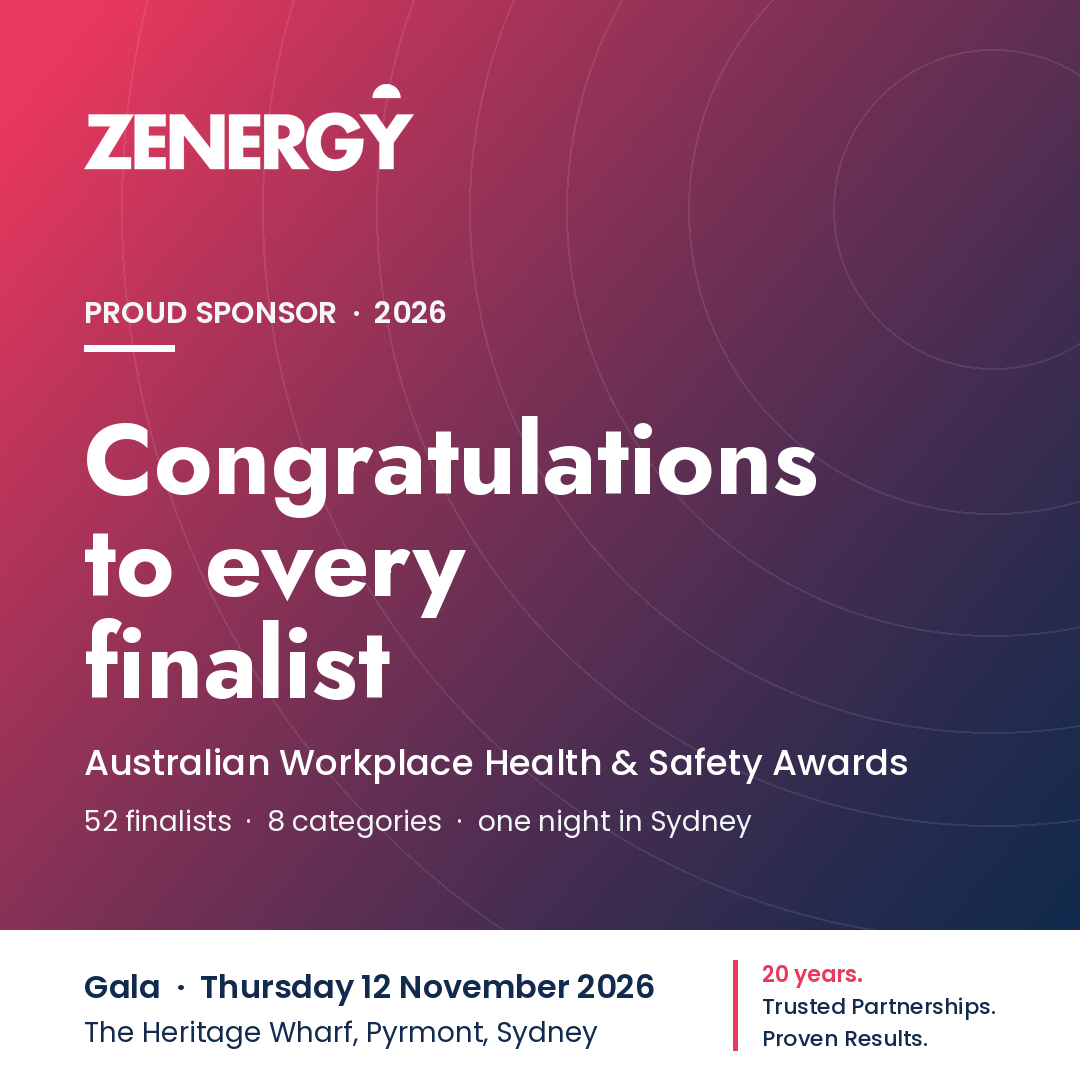
Zenergy Congratulates the 2026 AWHSA Finalists
By Dean Woods • October 13, 2026
Zenergy is proud to sponsor the 2026 Australian Workplace Health & Safety Awards. Meet the 52 finalists ahead of the Sydney gala on 12 November.
By Dean Woods • October 13, 2026
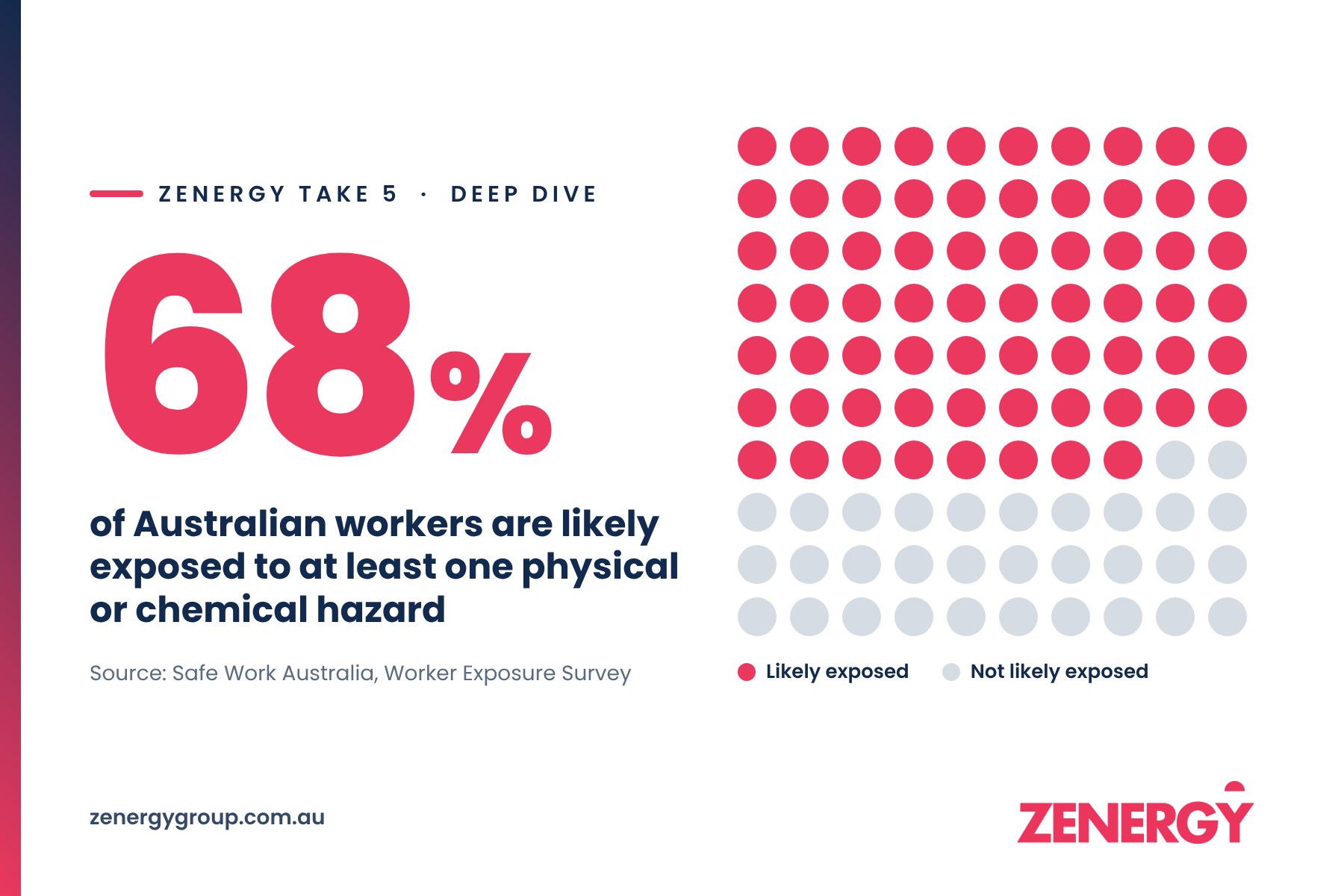
Welcome to Take 5, Zenergy's weekly five-minute scan of what's moving in Australian workplace health and safety, workers compensation and people & culture — five items, one featured senior role, every source named. This week: a hard regulatory deadline lands on the calendar, Safe Work Month hits its stride, and Safe Work Australia publishes the clearest picture in years of who is actually exposed to harm at work. 1. New workplace exposure limits commence 1 December — including Australia's first diesel particulate limit The transition period for Safe Work Australia's updated workplace exposure limits (WELs) for airborne contaminants ends on 1 December 2026. The list introduces Australia's first national exposure limit for diesel particulate matter — 0.01 mg/m³, measured as respirable elemental carbon — alongside revised limits for a range of other contaminants. Regulators are telling duty holders to use the remaining weeks to review exposure monitoring, confirm controls are effective, and prioritise elimination and engineering controls over reliance on RPE. If your operations involve diesel plant in enclosed or poorly ventilated environments — distribution centres, tunnels, underground mining, workshops — this is the compliance item to table at your next leadership meeting. Safe Work Australia has published guidance and a transition toolkit, and state regulators including SafeWork SA have flagged the change, as has NOPSEMA for offshore operators. Sources: Safe Work Australia — Changes to Workplace Exposure Limits (safeworkaustralia.gov.au); SafeWork SA — Get ready for new Workplace Exposure Limits (safework.sa.gov.au); NOPSEMA — Diesel engine emissions: new workplace exposure limit takes effect December 2026 (nopsema.gov.au). 2. Dates ahead: Safe Work Month's “for health” week and World Mental Health Day National Safe Work Month is underway, with Safe Work Australia's 2026 theme “Safe work is for life” running week-by-week focuses: “for health” (week two, this week), “for the future” (week three) and “for all” (week four). World Mental Health Day falls on Saturday 10 October, inside Mental Health Month — a natural prompt to put psychological health on the toolbox agenda, not just the poster wall. Regulators are active too: SafeWork NSW opened the month with a compliance operation targeting the meat processing sector. Sources: Safe Work Australia — National Safe Work Month (safeworkaustralia.gov.au/national-safe-work-month); SafeWork NSW — news, 1 October 2026 (safework.nsw.gov.au). 3. People & culture: FWO recovers $453 million for workers in 2025–26 The Fair Work Ombudsman's 2025–26 results, released 14 September, show $453 million recovered for underpaid workers across the year, with Ombudsman Anna Booth urging employers to find “compliance common ground”. For employers, the signal hasn't changed: payroll governance, award classification and record-keeping sit alongside WHS as enterprise-level compliance risks — and the regulator's recovery capability keeps growing. Worth a standing item on the people & culture risk register, especially for businesses with large award-covered or labour-hire workforces. Source: Fair Work Ombudsman media release, 14 September 2026 (fairwork.gov.au/newsroom). 4. Job market pulse: national vacancies ease, HSE demand holds The ABS's August 2026 Job Vacancies figures (released 1 October) show 325,000 vacancies nationally — down 0.9% over the quarter and 1.3% over the year, and 31.2% below the May 2022 peak. Private sector vacancies fell 2.0% for the quarter while public sector vacancies rose 7.8%. Health care and social assistance remains the deepest vacancy pool at 54,300. Against that gently easing backdrop, safety hiring is holding its ground from WHS advisors in Melbourne manufacturing to safety leadership in Queensland logistics — a spread we read as steady, sector-broad demand for proven operators rather than a hiring spike. Sources: ABS — Job Vacancies, Australia, August 2026 (abs.gov.au); 5. Industry story of the week: 68% of workers likely exposed to at least one hazard Safe Work Australia's newly published Worker Exposure Survey finds 68% of Australian workers are likely exposed to at least one physical or chemical hazard at work, with 28.9% experiencing high-level exposure. Solar UV is the most common hazard (an estimated 4.87 million workers), silica exposure covers an estimated 2.04 million workers and is heavily concentrated in construction and mining, and apprentices and trainees are disproportionately exposed across heat, silica, lead and asbestos. Construction, agriculture and mining are the industries most likely to see multiple hazard exposure. It's the week's most important read for HSE leaders — and the subject of this week's Zenergy deep-dive, where we unpack what the numbers mean for exposure monitoring, young-worker supervision and the 1 December exposure limit deadline. Sources: Safe Work Australia — Worker Exposure Survey (safeworkaustralia.gov.au); Safety Solutions, 28 September 2026 — “Over two-thirds exposed to a physical or chemical hazard, workers survey reveals”
By Dean Woods • October 7, 2026
Safe Work Australia's Worker Exposure Survey finds 68% of workers exposed to hazards. What HSE leaders should do before new limits land on 1 Dec.
City skyline at sunset with tall modern buildings under a colorful orange and blue sky
September 16, 2026
Explore the latest Safe Work Australia updates for 2026, including WHS penalties, incident notification, AI, chemical exposure limits and regulatory changes.
Worker in white hard hat and glasses speaking on a factory floor, with colleagues blurred in the background
September 9, 2026
Should you hire an HSE contractor or permanent HSE Manager? Explore when interim HSE solutions make sense for Australian businesses, projects and temporary vacancies.
HSEQ salary bands by role, Australia Q4 FY2026 – Zenergy
By Dean Woods • September 7, 2026
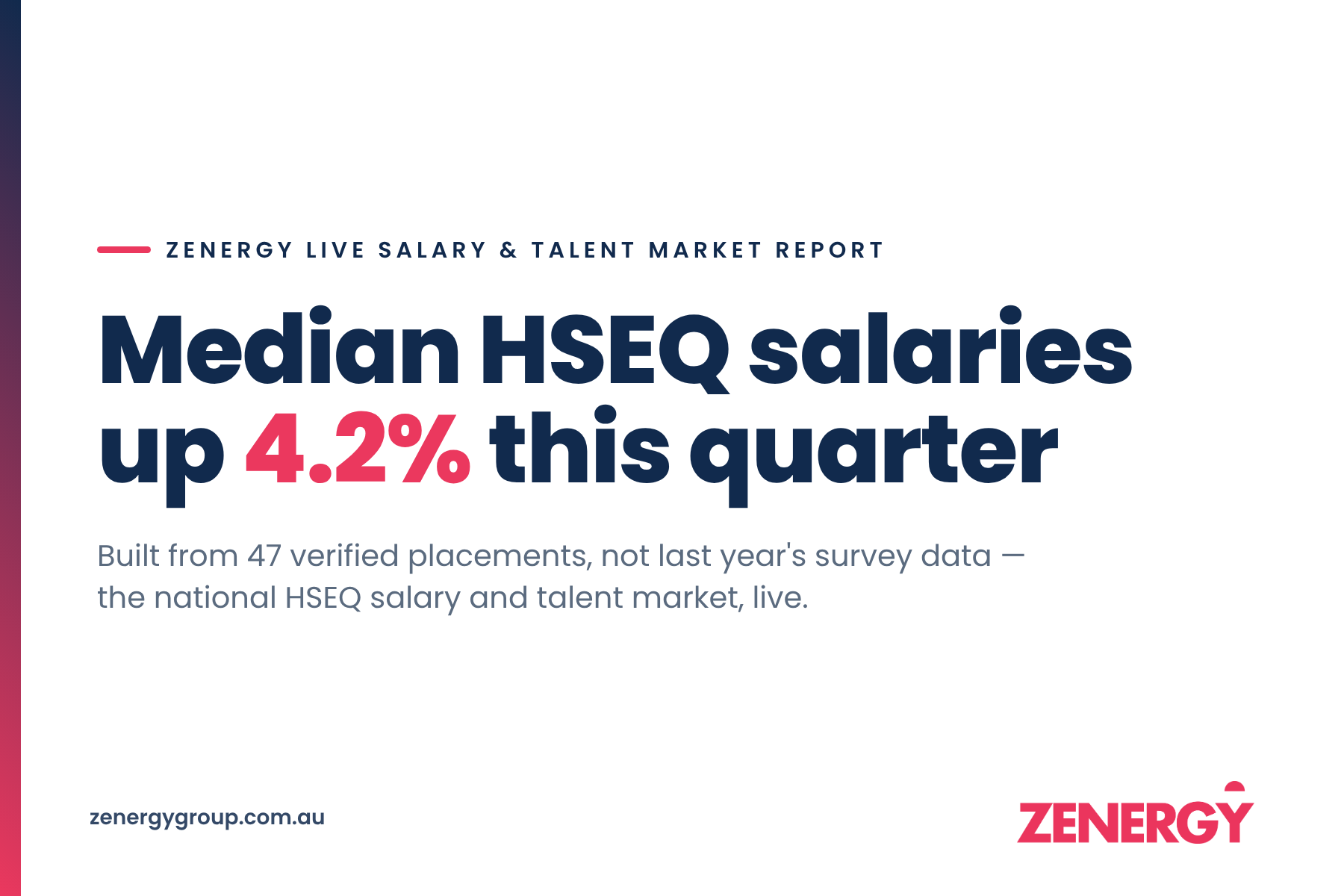
See live HSEQ salary data from 47 verified Zenergy placements — HSE Manager, WHS Advisor and Head of HSEQ pay bands, by city and company size.
More Posts