
Victoria's On-the-Spot Fines for Falls: An HSE Guide
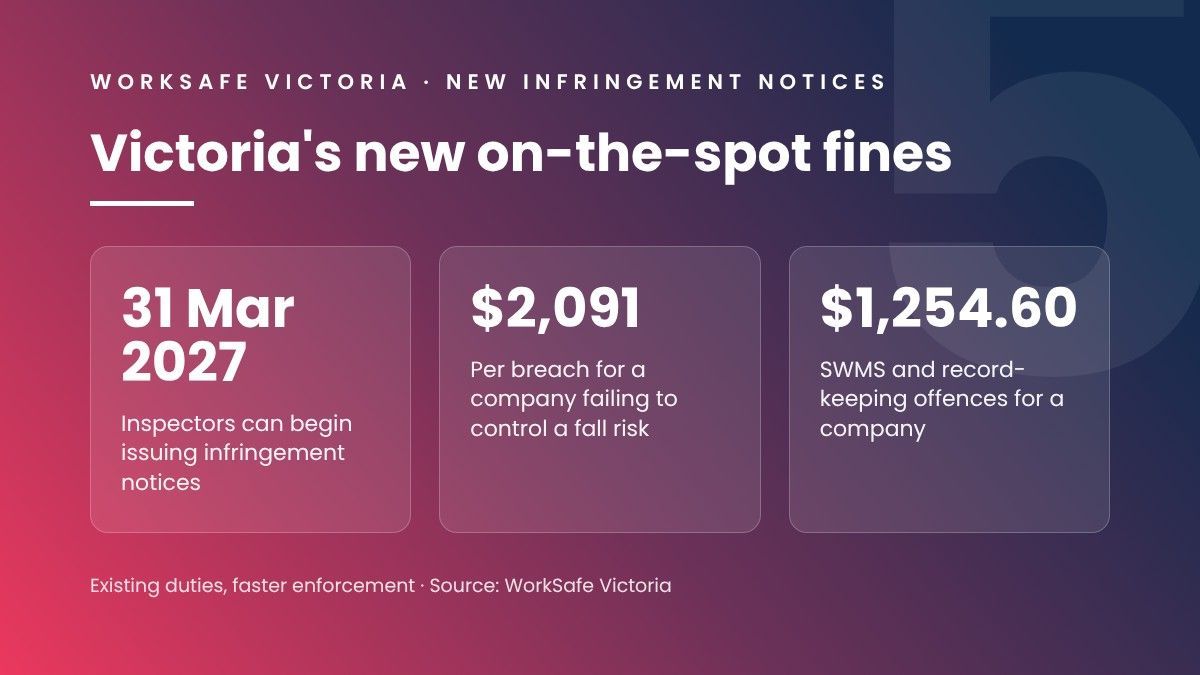
Victoria has put a date and a dollar figure on something the industry has watched coming since September: on-the-spot fines for fall-from-height and SWMS breaches. From 31 March 2027, a WorkSafe inspector who finds an uncontrolled fall risk won't need a prosecution to make it cost money — the fine can be written on the day.


On its own, a $2,091 infringement notice won't frighten a tier-one contractor. But read alongside what Victoria's courts and the national fatality data are doing, it marks a clear shift in how falls will be policed — and it deserves a line in every HSE leader's 2027 plan, not just in Victoria.


What changes on 31 March 2027

Under the Occupational Health and Safety Amendment (Infringement Offences) Regulations 2026, WorkSafe inspectors will be able to issue infringement notices for five existing offences under the OHS Regulations 2017: failing to use a control measure to manage the risk of a fall from height (reg 44A); relying only on administrative controls for a fall risk without creating the required record, or failing to keep that record accessible (reg 46); starting high-risk construction work without a Safe Work Method Statement (reg 327); and failing to keep a SWMS readily accessible (reg 329).


The fall-risk offence carries an infringement penalty of $2,091 for a company ($418.20 for an individual); the SWMS and record-keeping offences carry $1,254.60 for a company ($250.92 for an individual). Court penalties for the same offences remain far higher — up to $104,550 for a company on the fall-risk offence — and an inspector can still choose prosecution over a fine. Recipients can seek internal review or elect to have the matter heard in court.


The Victorian Government, which confirmed the commencement date and amounts on 21 October, has been explicit that no new duties are created. What changes is enforcement speed and certainty: offences that once sat behind the time and cost of a prosecution become same-day consequences. That is precisely what makes them likely to be used often.


The courts are hardening in parallel

A month before the announcement, WorkSafe showed it will also push back on lenient outcomes. In April 2024, an apprentice carpenter fell 3.24 metres through an unguarded skylight void on a Footscray townhouse development, briefly losing consciousness. Three companies engaged on the site pleaded guilty, and in May 2026 the Magistrates' Court fined them a combined $50,000 — without conviction.


WorkSafe appealed. On 23 September 2026, the County Court set aside those sentences, recorded convictions against all three companies, and more than doubled the combined penalty to $100,200. WorkSafe's Chief Health and Safety Officer Sam Jenkin called the failure to address fall risks after an incident "completely unacceptable behaviour" — inspectors had found workers at six metres without adequate fall protection two months after the apprentice's fall.


The message to duty holders is consistent at both ends of the scale: minor falls breaches will be fined on the day, and serious ones will be pursued past the first court outcome.


The national backdrop: falls still kill

Safe Work Australia's Key WHS Statistics Australia 2026 recorded 222 worker deaths in 2025 — the highest toll since 2012. Falls from height killed 28 of those workers, the second-largest single cause after vehicle incidents, and construction alone recorded 41 deaths. Falls are among the most preventable of the major killers: the controls are mature, codified and well understood. That combination — high harm, known controls — is exactly where regulators reach for faster enforcement tools, and there is no reason to assume Victoria will be the last jurisdiction to do so.


What HSE leaders should do before March 2027

  • Audit fall-risk controls against the hierarchy now. The infringement offence targets working without a control measure in place — passive protection, guardrails, void covers — not paperwork gaps. Walk the sites, not the system.
  • Treat the SWMS as a gate, not a document. The fineable moment is high-risk construction work commencing before a SWMS exists. Build the check into mobilisation and daily pre-starts.
  • Fix accessibility. A SWMS or fall-risk record that can't be produced when an inspector asks is its own offence. WorkSafe itself suggests a printed copy in the crib room or a QR-coded shared folder.
  • Brief frontline leaders. Supervisors and foremen are where an infringement notice will actually land. Make sure they know what inspectors can now fine, and that the day of the visit is too late to tidy up.
  • Close out notices fast and visibly. The Footscray appeal turned on what happened after the incident — workers were still exposed at height two months later. Post-incident inaction is the aggravator courts punish hardest.
  • Check your capability, not just your controls. Faster enforcement shifts weight onto day-to-day site presence: competent advisors who catch the uncovered void before the inspector does.


Where Zenergy fits

Twenty years of recruiting across every level of HSE leadership has taught us that enforcement changes like this one rarely create new work — they expose where capability is thin. If your Victorian projects are carrying vacant safety seats, or your 2027 plan includes strengthening site-level HSE capability — permanent, interim or project-based — talk to a Zenergy consultant. Browse current roles at zenergygroup.com.au/job-results, or get in touch at zenergygroup.com.au.


Sources

•     WorkSafe Victoria — New infringement notices for falls and high-risk construction work offences (worksafe.vic.gov.au/new-infringement-notices-falls-and-high-risk-construction-work-offences)

•     Premier of Victoria — Labor brings on-the-spot fines to unsafe worksites, 21 October 2026 (premier.vic.gov.au/labor-brings-spot-fines-unsafe-worksites)

•     WorkSafe Victoria — Construction companies' fines double on appeal, 1 October 2026 (worksafe.vic.gov.au/news/2026-10/construction-companies-fines-double-appeal)

•     Safe Work Australia — Key Work Health and Safety Statistics Australia 2026 (data.safeworkaustralia.gov.au/reports/key-whs-statistics-australia/latest-release)

•     The Good Builder — Victoria sets a date for on-the-spot falls fines, 26 October 2026 (thegoodbuilder.com.au)


Contact Us

Zenergy News

By Dean Woods • November 3, 2026
Welcome to Take 5, Zenergy's five-minute scan of what's moving in Australian workplace health and safety, workers compensation, and people and culture. This week: Victoria puts a date and a dollar figure on on-the-spot fines, the Fair Work Commission's generative AI rules take effect, and Safe Work Australia's annual data lands with a confronting headline number. 1. Victoria locks in on-the-spot fines for falls and SWMS breaches From 31 March 2027, WorkSafe Victoria inspectors will be able to issue infringement notices — on-the-spot fines — under the Occupational Health and Safety Amendment (Infringement Offences) Regulations 2026. The confirmed offences: failing to use a control measure for a fall risk (up to $2,091 for a company, $418.20 for an individual), starting high-risk construction work without a Safe Work Method Statement, and failing to keep a SWMS or required fall-risk records readily accessible (up to $1,254.60 for a company). The Victorian Government confirmed the start date and amounts on 21 October. No new duties are created — these are existing obligations. What changes is the speed of enforcement: a breach an inspector once handled with a notice or a long prosecution can now cost money the same day. We unpack what it means, and what the courts are doing in parallel, in this week's deep dive. Also on the radar: Australia's new Workplace Exposure Limits replace the old exposure standards from 1 December 2026 — one month out. If your chemical register and SDS library haven't been checked against the new limits, now is the time (Safe Work Australia). Sources: WorkSafe Victoria — New infringement notices for falls and high-risk construction work offences (worksafe.vic.gov.au/new-infringement-notices-falls-and-high-risk-construction-work-offences); Premier of Victoria media release, 21 October 2026 (premier.vic.gov.au/labor-brings-spot-fines-unsafe-worksites); Safe Work Australia — New workplace exposure limits (WEL) to apply from 1 December 2026 (safeworkaustralia.gov.au). 2. Key dates: Movember and the Australian Workplace Health & Safety Awards Movember runs all month, putting men's health — mental health and suicide prevention, prostate and testicular cancer — on the agenda. It's a natural fit for safety teams in male-dominated industries: 93% of the workers who died at work in 2025 were men (Safe Work Australia). A toolbox talk, a fundraising crew or a wellbeing check-in all count. On the calendar: the 2026 Australian Workplace Health & Safety Awards run 12–13 November in NSW, and AIHS branches host events through the fortnight, including the South Australian Safety Breakfast on 5 November (AIHS events calendar). Sources: Movember (movember.com); AIHS events (aihs.org.au); Safe Work Australia — Key WHS Statistics Australia 2026. 3. People & culture: the Fair Work Commission's generative AI rules are now in force New Fair Work Commission guidance on the use of generative AI in Commission matters took effect on 20 October. Anyone who uses generative AI to help prepare a document lodged in a case must disclose that use — and a person must verify that every fact, case and quote in the document exists and says what it's claimed to say. Asking another AI tool to check doesn't count. The guidance reaches further than many employers expect: an HR adviser representing their own employer falls within the definition of a professional representative. Documents that don't comply can be given less weight, disregarded, or in serious cases see the matter dismissed with costs. If your HR team touches unfair dismissal responses, witness statements or submissions, map where AI is being used and put a verification step in writing (Fair Work Commission; HRD Australia, 20 October 2026). Sources: Fair Work Commission (fwc.gov.au); HRD Australia — Fair Work Commission AI disclosure rules now in force for employers, 20 October 2026 (hcamag.com). 4. Job market pulse: vacancies ease, construction holds The ABS's latest Job Vacancies release (August 2026 quarter, published 1 October) counted 325,000 vacancies nationally, down 0.9% over the quarter and 1.3% over the year. Private sector vacancies fell 2.0% to 286,300 while public sector vacancies rose 7.8% to 38,700 — and construction vacancies held broadly steady at around 20,000. For HSE hiring, that reads as a market that has cooled from its peak but is still competitive for proven safety talent, particularly in construction and infrastructure. Sources: ABS — Job Vacancies, Australia, August 2026 (abs.gov.au); SEEK (seek.com.au). 5. Industry story of the week: 222 lives — Australia's worst year since 2012 Safe Work Australia's Key Work Health and Safety Statistics Australia 2026, released in October, confirms that 222 workers died at work in 2025 — the highest annual toll since 2012 and well above the five-year average of 197. Vehicle incidents accounted for 92 deaths, falls from height 28 and falling objects 21: together, nearly two-thirds of the total. Construction recorded 41 deaths; transport, postal and warehousing the most of any industry at 61. The compensation data tells its own story. Around 147,200 serious claims were lodged in 2024–25, and mental health conditions now account for 17,900 of them — 12.2% of the total, up 169% since 2014–15. A typical mental health claim involves a median 34.8 weeks off work and $68,600 in compensation, roughly five times the time lost of other serious claims. "The data is confronting, but it also tells us where action is needed," said Safe Work Australia CEO Marie Boland. Sources: Safe Work Australia — Key WHS Statistics Australia 2026 (data.safeworkaustralia.gov.au/reports/key-whs-statistics-australia/latest-release) and media release, October 2026 (safeworkaustralia.gov.au). Featured role: Health & Safety Manager - $175,000 + Sydney NSW | Permanent, full time Our client is a large, well-established organisation operating across a diverse range of business functions and operational environments. With a broad workforce and complex risk profile, the organisation is committed to strengthening its health and safety practices, improving consistency and embedding a proactive approach to risk management. Apply via the Zenergy job board —for a confidential conversation call the team on 1300 333 400 Hiring HSE talent, or weighing your own next move? Talk to a Zenergy consultant — 20 years of trusted partnerships across every level of HSE leadership. Visit zenergygroup.com.au.
WHS news Australia
By Dean Woods • October 25, 2026
This week: the Best Practice Review of the model WHS laws, new Clerks Award work-from-home rules, job market data and a featured Sydney HSE Manager role.
Best Practice Review model WHS laws
By Dean Woods • October 25, 2026
Safe Work Australia's first national WHS review since 2018 makes 21 recommendations. What they cover and what HSE leaders should do before they become law.
Fake Safety Certificates: An HSE Hiring Wake-Up Call
By Dean Woods • October 19, 2026
WorkSafe Victoria is investigating fake safety qualifications. How employers should verify tickets, licences and real competency when hiring HSE talent.
Zenergy Take 5: WHS News for the Week of 19 October 2026
By Dean Woods • October 19, 2026
Queensland’s psych injury claims shake-up, fake safety certificates under investigation, fresh job market data and this week’s featured HSE role.
Zenergy Congratulates the 2026 AWHSA Finalists
By Dean Woods • October 13, 2026
Zenergy is proud to sponsor the 2026 Australian Workplace Health & Safety Awards. Meet the 52 finalists ahead of the Sydney gala on 12 November.
More Posts