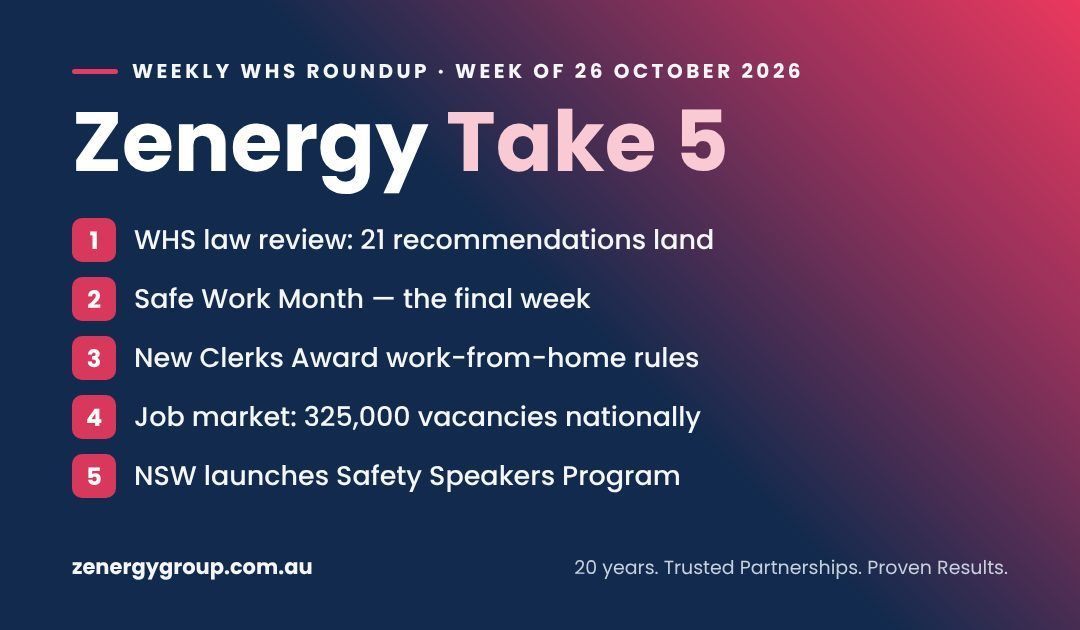
Australia's WHS laws just had their first national review since 2018. Here's what its 21 recommendations mean for HSE leaders
On 19 October, Safe Work Australia published the final report of the Best Practice Review of the model work health and safety laws — the first top-to-bottom national review since Marie Boland's 2018 report. It makes 21 recommendations to WHS ministers. None of them is law yet. All of them tell you where the system is heading, and the smartest HSE leaders will not wait for commencement dates to start moving.
Why this review, and why now
The review was commissioned against a hard backdrop. According to the report, 222 workers died from traumatic injuries in 2025 — the highest annual toll since 2012 — after 188 deaths in 2024. The longer arc is better: the fatality rate has fallen around 24% since 2014, from 1.7 to 1.3 deaths per 100,000 workers. But progress has stalled against the national target of cutting the rate by at least 30% over the decade to 2033, and the review is blunt that incremental tinkering will not close that gap.
Consultation ran from September 2025 to March 2026, taking in workers, HSRs, employers and regulators across every jurisdiction. Two findings frame everything else: support for harmonised national laws remains strong, and the gaps that worry people most — psychological harm, new technology, climate exposure — are precisely where the current framework is thinnest.
The recommendations that will matter most
Psychosocial risk moves to the centre. The review recommends lifting the risk management framework from the WHS Regulations into the WHS Act itself, so the hierarchy of control unambiguously applies to psychosocial hazards. For employers who have treated psychological health as a policy exercise rather than a risk discipline, that distinction will bite — it aligns the legal architecture with what regulators like SafeWork NSW are already enforcing in the field.
Codes of practice get teeth — and reach. Approved codes would carry “deemed compliance” status: following the code is taken as meeting the duty for the matters it covers, while duty holders choosing another path must be able to prove it is at least as good. New industry-specific codes are recommended, starting with retail, education and training, agriculture and construction, with model codes applying automatically in model-law jurisdictions once ministers agree them.
Accountability tightens. The review recommends prohibiting insurance and indemnity arrangements for the legal costs of defending WHS prosecutions (penalties are already uninsurable), limiting non-disclosure agreements that obstruct safety investigations, and giving general standing for private WHS prosecutions where regulators do not act, reviewed after three years. Health and safety representatives would gain stronger powers, training entitlements and consultation rights.
The future-risk agenda is explicit. National strategies are recommended on AI and digital technology (including workplace surveillance and work intensification), on climate-related risks — with new model regulations flagged for extreme heat and air quality — and on harmful workplace behaviours including violence and harassment. For construction, the review proposes replacing the $250,000 construction project threshold with a headcount test of five or more workers, which would bring many smaller jobs under project-level rules.
Nothing is law yet — but the direction is set
Every recommendation now goes to WHS ministers, and changes only take effect as each parliament legislates. Past reviews suggest the timeline will be measured in years, not months, and not every recommendation will survive intact — the 2018 review's industrial manslaughter recommendation took years to roll through the jurisdictions, but roll through it did.
That is exactly why the report matters now. It is the clearest available statement of regulatory intent in a decade, and boards, officers and HSE leaders will be judged against its themes long before the ink dries on any amendment act.
What HSE leaders should do now
• Pressure-test your psychosocial risk management against the hierarchy of control — not just your policies. If your controls stop at training and EAP referrals, start the redesign conversation now.
• Map your code-of-practice position. Deemed compliance cuts both ways: knowing exactly where you follow each applicable code, and where you deliberately depart and why, becomes a defensible-position exercise.
• Brief your officers. Due diligence under section 27 will be read against the review's themes — surveillance and AI, heat, harmful behaviours — well before they are regulated.
• Check your D&O and statutory liability arrangements against the proposed ban on insuring WHS defence costs, and ask what that does to personal risk appetite at officer level.
• If you operate in retail, education, agriculture or construction, expect your sector's code to arrive first — and get your voice into the drafting consultation.
The capability question behind all of it
Strip the legal detail away and the review is asking one question of every organisation: do you have the safety capability to manage psychosocial, technological and climate risk with the same rigour as physical risk? In twenty years of placing HSE leaders, we have watched each regulatory step-change — harmonisation, industrial manslaughter, the psychosocial regulations — translate directly into demand for safety professionals who can operate at board level, not just at the rail or the gate. This review signals the next one. The organisations that hire and develop that capability early will meet the new rules as business as usual; the rest will meet them as a scramble.
Reviewing your HSE structure, or building the team that will carry you through the next wave of reform? Talk to a Zenergy consultant for a confidential conversation — 20 years. Trusted Partnerships. Proven Results.
Sources
• Safe Work Australia — Best Practice Review of the model WHS laws, Final Report, October 2026 (safeworkaustralia.gov.au, published 19 October 2026)
• Safe Work Australia — work-related traumatic injury fatalities data, as reported in the Final Report
• SafeWork NSW — media releases, October 2026 (safework.nsw.gov.au/news)
Contact Us
Zenergy News