What qualifications and experience should I look for when hiring a WHS professional?
The short answer
When hiring a WHS professional in Australia, match the qualification to the level of the role. Look for a Certificate IV in Work Health and Safety (BSB41419) as the minimum for coordinator and officer roles, a Diploma (BSB51319) or tertiary study for advisor roles, and a Bachelor's degree, Graduate Diploma or Masters in OHS for manager and executive roles. Then test for the experience that actually predicts performance: the critical risks in your industry, the WHS or OHS laws in your state, psychosocial risk management, management systems such as ISO 45001, incident investigation, and the ability to influence leaders and frontline teams. Finally, verify every qualification and licence before you make an offer.
Start with the role, not the résumé
The most common hiring mistake we see in 20 years of HSE recruitment is a mismatch between the job and the qualification sought. A site-based HSE Advisor on a Tier 1 civil project needs a different profile from a Head of Health, Safety and Wellbeing reporting to the board.
Before you write the ad, answer three questions:
- Is the role operational or strategic? Is the person running inspections, prestarts and investigations, or shaping the safety strategy, governance and reporting to executives?
- What are your critical risks? Working at heights, mobile plant, rail corridor, hazardous chemicals, psychosocial hazards, heavy vehicle Chain of Responsibility (CoR) — the right experience depends on what can seriously hurt your people.
- Which law applies? Most states and territories run the harmonised model WHS laws; Victoria operates under the Occupational Health and Safety Act 2004. Experience in your jurisdiction shortens the ramp-up.
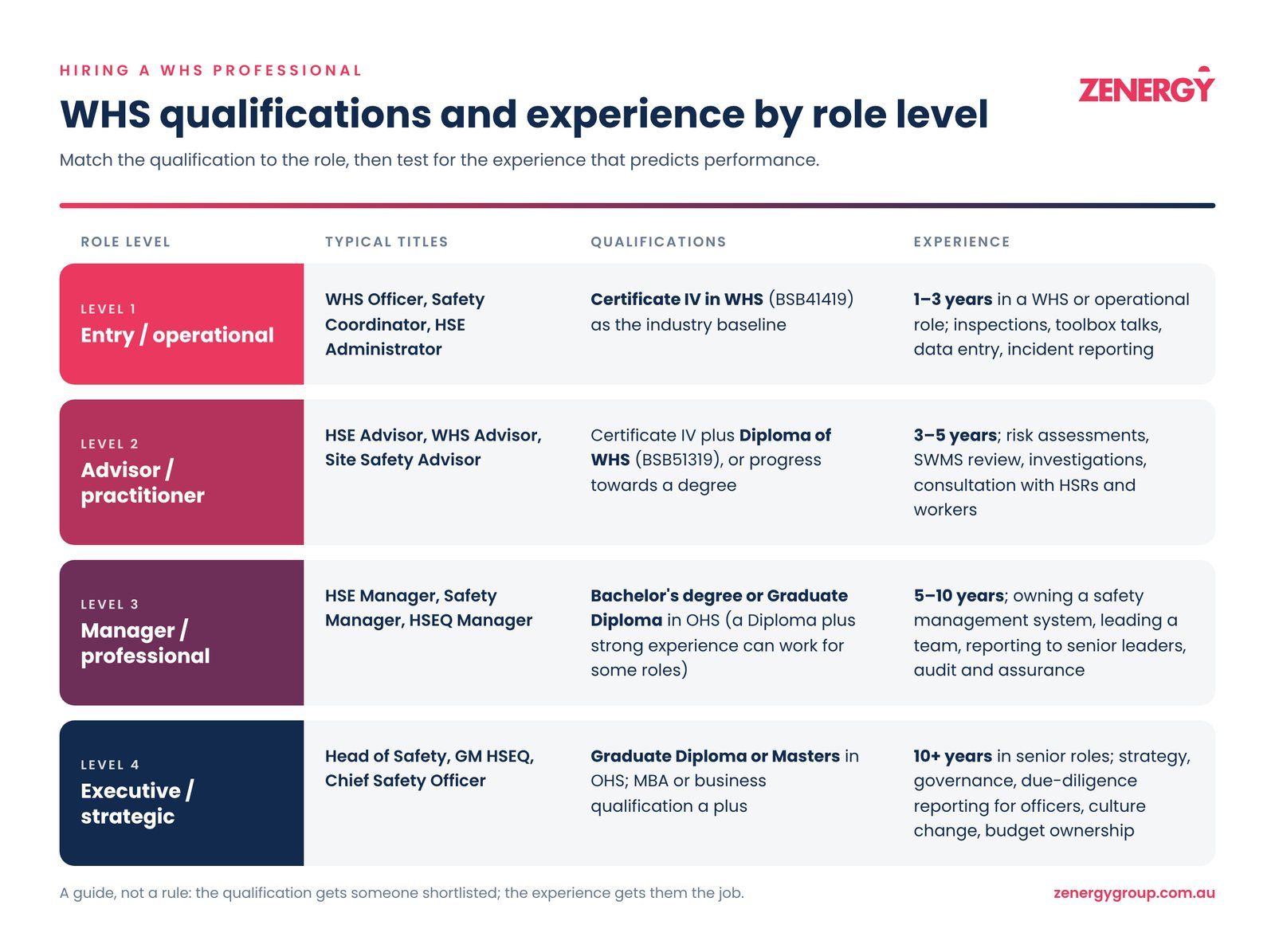
These are guides, not rules. A strong practitioner with deep site experience and a Diploma can outperform a degree-qualified candidate who has never worked in your environment. The qualification gets someone on the shortlist; the experience gets them the job.
AIHS certification: a useful benchmark
The Australian Institute of Health & Safety (AIHS) certifies generalist OHS practitioners and professionals at three levels. It's one of the clearest signals of capability available to employers:
- Certified OHS Practitioner — operational roles such as WHS Officer, HSE Advisor and Safety Coordinator.
- Certified OHS Professional — senior roles such as Safety Manager and HSE Manager. It requires a university OHS qualification (Bachelor's, Graduate Diploma or Masters) and at least three years in a professional health and safety role, plus a reflective practice assessment and referees.
- Chartered OHS Professional — executive roles such as Group Head of HSE or Chief Safety Officer. It requires a Masters and at least 10 years in senior health and safety roles.
Certification also requires ongoing AIHS membership and continuing professional development, so it tells you the person is keeping their knowledge current. Note that a Graduate Certificate on its own doesn't meet the qualification requirement for professional certification.
The experience that predicts performance
Qualifications show what someone has studied. Experience shows what they can do. When interviewing, look for evidence of:
- Critical risk control in your sector. Ask for a specific example of a high-consequence risk they controlled, and how they verified the controls were working.
- Psychosocial risk management. Psychosocial hazards are now regulated in every jurisdiction. Victoria's Occupational Health and Safety (Psychological Health) Regulations 2025 commenced on 1 December 2025. Look for hands-on experience with risk assessment, work design and consultation, ideally aligned to ISO 45003.
- Management systems. Experience building, maintaining or auditing a system to ISO 45001 (often alongside ISO 14001 and ISO 9001 in HSEQ roles). A Lead Auditor qualification is a plus for assurance-heavy roles.
- Incident investigation. Formal training in a recognised method such as ICAM or TapRooT, and examples of findings that led to lasting change.
- Consultation and influence. Working with HSRs and committees, and coaching supervisors and executives. The best WHS professionals change behaviour through credibility, not policing.
- Data and reporting. Turning lead and lag indicators into insight that boards and officers can act on as part of their due-diligence duties.
Specialist tickets and sector requirements
Some industries need more than a generalist WHS qualification. Depending on your sector, you may need:
- Transport and logistics: CoR knowledge under the Heavy Vehicle National Law.
- Rail: Rail Industry Worker (RIW) accreditation and experience with rail safety management under the Rail Safety National Law.
- Mining and resources: statutory roles and state-specific mining safety qualifications.
- Health and hygiene: occupational hygiene expertise for exposure monitoring, which matters as workplace exposure limits replace exposure standards.
- Wellbeing roles: Mental Health First Aid, psychology or allied health backgrounds for health and wellbeing specialists.
Always verify qualifications
In October 2026, WorkSafe Victoria announced it was investigating safety risks linked to individuals allegedly obtaining fraudulent qualification certificates, uncovered through a Victoria Police operation. WorkSafe's message to employers was clear: a certificate alone isn't proof that someone is competent to do the work safely.
Before making an offer:
- Check the training provider is a registered RTO on the National Register (training.gov.au), and ask the candidate to share their USI transcript for nationally recognised training.
- Confirm university qualifications directly with the institution.
- Check AIHS certification status and any licences directly with the issuer.
- Take detailed references that test the specific achievements on the résumé.
This isn't just good practice. Hiring someone into a safety-critical role without verifying their competence is itself a WHS risk.
Red flags to watch for
- Qualifications completed in an unrealistically short time from an unknown provider.
- Lots of policy-writing, little evidence of time in the field.
- Achievements described only as "we", with no clear personal contribution.
- No current knowledge of recent law changes, psychosocial duties or exposure limit changes.
- An enforcement-only mindset — safety by clipboard rarely builds a lasting culture.
Frequently asked questions
Is a Certificate IV in WHS enough to hire someone as a safety advisor? For entry-level and coordinator roles, yes — it's the common industry minimum. For advisor roles with real autonomy, look for a Diploma or tertiary study plus three or more years of experience.
Does a WHS Manager need a university degree? Not always, but it's increasingly expected. A Bachelor's or Graduate Diploma in OHS is the benchmark for professional-level roles and is required for AIHS Certified OHS Professional status.
What's the difference between WHS, OHS and HSE? They describe largely the same discipline. WHS is used under the harmonised model laws, OHS is used in Victoria, and HSE or HSEQ is common where the role also covers environment and quality.
How many years of experience should a Head of Safety have? Typically 10 or more years, including several in senior roles leading teams, setting strategy and reporting to executives or boards.
How can I check if a WHS qualification is genuine? Confirm the RTO is on the National Register, ask for the candidate's USI transcript, contact universities directly and take thorough references.
How Zenergy can help
Zenergy has specialised in health, safety and environment recruitment since 2006. We recruit across every level of HSE leadership, from WHS Coordinators to GMs of HSEQ, through permanent recruitment, executive search and interim solutions, with offices in Sydney, Melbourne, Brisbane, Adelaide and Perth.
Every candidate we put forward has been interviewed by a consultant who understands the work, with qualifications and references checked before they reach your shortlist.
Hiring a WHS professional? Talk to our team on 1300 333 400 or email dean.woods@zenergygroup.com.au for a confidential conversation.
Looking for your next WHS role? Browse current opportunities on the Zenergy job board: zenergygroup.com.au/job-results
Contact Us
Zenergy News