Safety Leadership in Complex Operations: Insights from Dr Emily Novatsis
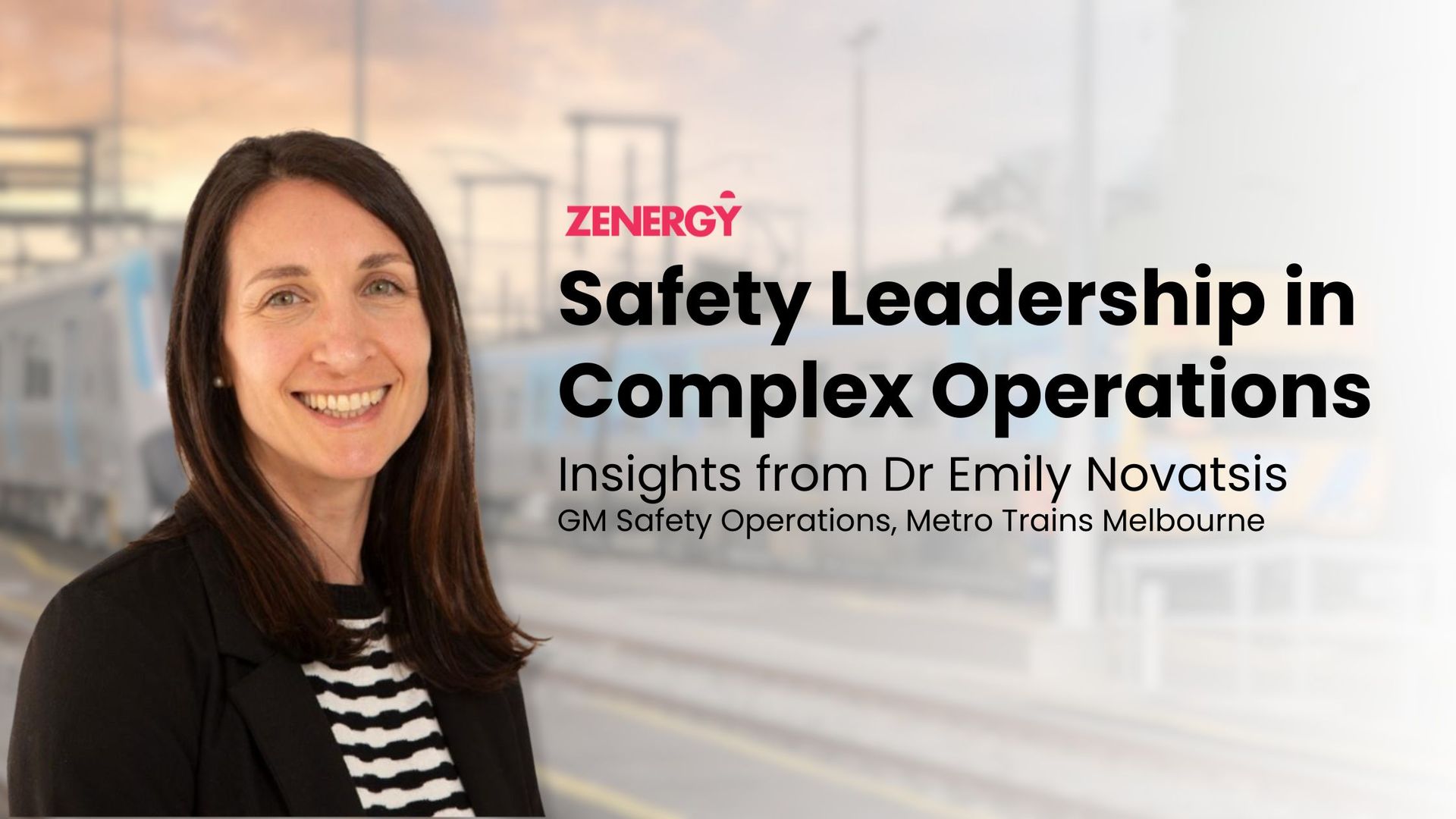
A conversation with Dr Emily Novatsis
Dr Emily Novatsis is General Manager, Safety Operations at Metro Trains Melbourne, where she leads a large multidisciplinary safety and security function supporting operational rail services across the Melbourne network. With more than two decades of experience in safety-critical industries, Emily is a respected safety leader known for connecting frontline operational realities with strategic decision-making.
A registered organisational psychologist with deep expertise in human and organisational factors, Emily’s work focuses on strengthening safety leadership, improving risk governance, and ensuring complex operational systems support people to perform safely. Her role spans both strategic oversight and operational execution — from enterprise safety governance and risk management through to frontline safety operations, investigations, emergency management, and security.
We spoke with Emily about safety leadership in complex environments, shifting from compliance to performance-based safety, and the challenges of introducing new infrastructure such as Melbourne’s Metro Tunnel.
Safety Leadership
In a complex, live rail environment, how do you ensure safety leadership remains visible and authentic — not just at executive level, but embedded in frontline decision-making?
Safety leadership begins with visibility in the field. Understanding operational risks and the effectiveness of controls comes from spending time with frontline staff — asking questions, listening carefully, and verifying that people understand both the risks in their roles and the influence they have in managing them.
“You can’t do safety from behind a desk,” Emily explains. “You need to spend time with the people who are managing risk day-to-day. That’s where you understand how things are really working.”
Those conversations often reveal whether teams are drifting from what is expected and, importantly, why. Sometimes expectations may not be practical, or there may be better ways of doing things. Identifying and closing those gaps — and feeding that learning back to teams — helps strengthen both trust and safety outcomes.
In a large operational environment, assurance systems also play a critical role. Leaders rely on multiple layers of assurance across the organisation to maintain visibility of risk. For Emily, the focus is on quality rather than quantity.
“It’s not about how many inspections or interactions you record,” she says. “It’s about whether they are genuinely testing risk controls and whether the actions coming out of audits, investigations and inspections are actually being closed out adequately.”
Ultimately, a strong safety management system should detect when things begin to drift and provide confidence that operational risks are being managed effectively.
How have you shifted the conversation from compliance-driven safety to performance-driven safety across operations?
Moving beyond compliance begins with shifting the conversation from rules to risk. This means ensuring that risk registers are clear and well understood, and that the people responsible for risks and controls know exactly what they are accountable for. Rather than asking whether teams are following procedures, the focus becomes whether controls are working effectively in practice.
“It’s about helping risk owners understand what they’re accountable for,” Emily explains. “They need to understand their risk profile and how effectively those controls are working in the field.”
This approach moves safety away from a box-ticking exercise and toward understanding how resilient the system really is. Safety governance meetings are therefore structured around critical risk and assurance rather than compliance reporting.
Emily also emphasises the importance of human and organisational factors in understanding safety performance.
“Safety management is a system,” she says. “It’s about the interaction between people, procedures, equipment and the broader operational environment. Safety is improved by understanding how these aspects of the system interact to influence performance.”
Investigations are another key learning opportunity. Rather than focusing solely on what went wrong, the goal is to identify system improvements that better support frontline operators and strengthen resilience — preventing issues where possible, detecting them earlier, and recovering more effectively when they occur. Emphasis also needs to be on learning from what goes well, because most of the time, people get things right.
What leading indicators or cultural signals do you pay closest attention to when assessing the maturity of safety culture within your teams?
Some of the most revealing signals of safety culture appear in the small things.
“Simple observations tell you a lot,” Emily says. “Did someone ask me to sign in? Is the safety notice board up to date? Are local safety meetings happening, and are actions actually being progressed?”
These details often prompt useful conversations. If actions from safety meetings remain open for months, it raises questions about whether teams know how to escalate issues or whether they are receiving the support they need to resolve them. Direct engagement with frontline staff also provides valuable insight into culture. Emily looks to understand whether people are clear about the critical risks in their roles and whether they recognise the influence they have in managing them.
In station environments, for example, a key risk is the platform–train interface. Staff play an important role in managing that risk through actions such as making clear announcements, maintaining a visible presence on platforms, and intervening when passengers behave in ways that could put themselves in danger.
Technology is increasingly supporting this awareness. Systems can now detect unusual behaviour on platforms — such as someone sitting too close to the edge or entering the track area — allowing operational teams to respond quickly.
At the same time, interventions must be balanced with other operational risks. “There’s always a balancing act,” Emily explains. “You might reduce one risk for a passenger but increase another risk for staff, particularly in environments where occupational violence can occur.”
Ultimately, a mature safety culture is one where people understand risk, feel empowered to act, and trust that their concerns will be heard and addressed.
Major Projects – Metro Tunnel
With major infrastructure programs such as the Metro Tunnel, what are the most significant safety challenges when transitioning from construction to live operations?
Large infrastructure programs introduce entirely new systems, technologies, and operational risks into the network.
One of the first priorities is ensuring that any residual risks are being managed and temporary administrative controls left from the project phase are replaced with sustainable controls where possible. At the same time, organisations must remain alert to safety issues that only emerge once systems begin operating in real conditions.
Operational safety teams also play a significant role in preparing the organisation for new infrastructure.
“New infrastructure and systems can introduce new risks,” Emily explains. “Our team was heavily involved in reviewing risk registers, assessing hazards and ensuring appropriate controls were documented and owned.”
The introduction of platform screen doors is one example of new infrastructure requiring risk assessment and operational controls. Teams were also responsible for developing emergency management plans for the new stations and coordinating with emergency services to ensure readiness from day one.
The Metro Tunnel project also introduced new signalling technology through communication-based train control (CBTC), which allows trains to operate closer together, increasing network capacity.
Introducing this technology required significant work updating safety management system documentation and translating complex engineering information into practical guidance for operational staff. “We were taking dense engineering documents and turning them into something drivers and train controllers could actually use,” Emily says. “If people can’t understand the work instructions, it won’t support safe operations.”
As with any major project transition, embedding new systems, supporting teams as they learn to work with them, and building resilience for degraded operating modes are critical steps in establishing safe and stable operations.
About the Authors
This article was co-written by Jo Retallick, Manager, Southern Region, and James German, Senior Recruitment Consultant at Zenergy.
Together, they bring deep recruitment expertise across workplace health, safety, and sustainability, offering insights into the skills, leadership, and capabilities required to succeed in complex safety environments.

Contact Us
Zenergy News